
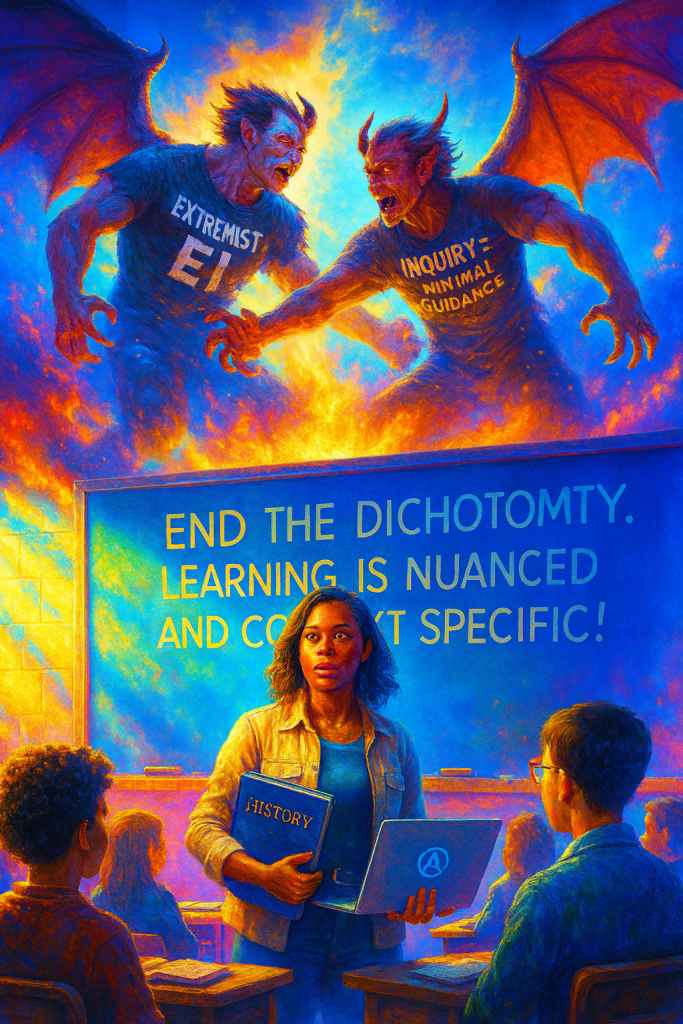
There’s something brittle about education’s recurrent discourse around Explicit Instruction (EI) and Inquiry. For all the energy it generates, the debate feels stale – locked in false binaries and riddled with misrepresentations. Lately, I’ve been returning to the work of Sweller, Dreyfus, and especially John Dewey, trying to find a more honest, rigorous way forward. What I’ve found is that the loudest voices in this debate – particularly some advocates of what I’ll call “extremist EI” – aren’t really arguing against historical inquiry at all.
They’re arguing against a caricature of it.
And it’s time we call that out.
Dewey Wouldn’t Be on Either Side
A big chunk of my early literature review was spent investigating the history of historical pedagogy. I found myself doing a deep dive in the work of John Dewey. With some luck, I’ll have a peer-reviewed journal article published on this topic in the near future.
My belief is that Dewey’s pragmatism was allergic to what he called the “either/ors”. In this way he upset both the ‘trads’ and ‘progs’ of his time. Dewey consistently argued that the learning environment, the learner’s needs, and the task at hand all mattered… and that the teacher playd a significant role in negotiating that space.
In today’s Australian context, I think he’d agree with the phrase: “Know learners and how they learn” (AITSL). He wouldn’t be OK with a cookie-cutter, one-size-fits all approach to teaching that privileges templates for delivering learning. He’d see the process of educating as much richer and much more nuanced. I think he might struggle with the misapplication of the concept of ‘fidelity’ between classroom contexts and teachers. I suspect he’d be more comfortable than many modern teachers and administrators with teachers being responsive and flexible in the moment with their classes to delivery effective learning.
I think he’d argue that context matters. Pedagogy must adapt.
For Dewey, extreme EI-only positions are just as flawed as leaving students to flounder without guidance.
Both the false binary positions of moder educational debates are poor representations of best practice educational thinking – and neither reflect what actually happens in effective history classrooms.
The Strawman Problem in the EI vs Inquiry Debate
Let’s me be specific about what I believe is happening in the dichotomous EI v Inquiry debate.
When ‘extremist EI’ advocates argue against historical inquiry, they are often not engaging with the real thing. They’re tearing down distorted, oversimplified versions of inquiry-based teaching. It’s the rhetorical move known as the strawman argument: you misrepresent your opponent’s position to make it easier to defeat.
Here’s what that looks like in practice:
Strawman 1: “It’s Just Unstructured Discovery”
The Misrepresentation:
“Historical inquiry just means throwing a bunch of sources at students and letting them figure it out with no guidance.”
The Reality:
Well-designed historical inquiry is structured, guided, and scaffolded. It includes modelling, direct instruction in disciplinary skills, curated sources, guiding questions, and lots of teacher intervention. The teacher isn’t removed – they’re reframed as a facilitator, coach, and expert modeler.
My Argument:
This strawman ignores everything we know about real historical inquiry models and how they function in the classroom. No serious history educator advocates for leaving students without support or context. This isn’t Dewey. It’s not Seixas. It’s not Wineburg. And it’s certainly not what happens in my classroom.
Strawman 2: “It Disregards Factual Knowledge”
The Misrepresentation:
“Inquiry-based learning throws knowledge out the window. It’s all vague skills with no substance.”
The Reality:
This is a false dichotomy. Historical inquiry absolutely relies on factual knowledge – students can’t source or contextualise documents without it. The best inquiry models integrate knowledge and skills in mutually reinforcing ways. The goal isn’t to discard facts, but to use them in meaningful, interpretive, and disciplinary ways.
My Argument:
If students don’t know anything, they can’t inquire in a meaningful way. My students know my mantra of “Let’s not just share ignorance!” But if students only memorise without analysing, they haven’t really learned history either. Good teaching builds both knowledge and the capacity to use it well.
Strawman 3: “Inquiry is Elitist and Impractical”
The Misrepresentation:
“Inquiry only works for gifted students. Most kids need straightforward content delivery to cope. Kids need EI.”
The Reality:
Historical inquiry can, is, and must be scaffolded. Historical inquiry in the classroom is not about abandoning struggling learners. It’s about helping all students build agency, curiosity, and cognitive resilience. This is not about efficiency, it’s about deep learning – and yes, it takes time.
My Argument:
Inquiry isn’t for the elite; it’s for everyone. But it needs to be well-structured, inclusive, and responsive. And that’s what skilled teachers do.
Misusing Sweller to Win a Debate
Perhaps the most egregious part of the extremist EI argument is the way Sweller’s work has been selectively used, often by ‘experts’ who are divorced from actual classroom practice, to promote a rigid, one-size-fits-all pedagogy that undermines both learning and teacher autonomy.
Yes, Cognitive Load Theory (CLT) correctly tells us that novices struggle with open-ended, minimally guided learning. That’s fair. But Sweller also identifies the expertise reversal effect – a well-documented phenomenon that shows explicit instruction becomes counterproductive as learners gain skill. He champions guidance fading, which means the level of instructional support must change as students become more competent.
This idea maps directly onto Dreyfus’ five-stage model of skill acquisition: novices need rules, but experts operate through intuition and context sensitivity. Teaching practices must evolve as students’ progress.
Rigid EI-all-the-way approaches ignore this basic principle of learning science.
Teaching at the Intersection of Minds and Machines: AI, Cognitive Load, and Deweyan Inquiry
This challenge isn’t just theoretical. With AI now in classrooms – particularly history classrooms – the need for pedagogical agility is more urgent than ever. History teachers working with generative AI are being asked to design learning environments that are simultaneously cognitively manageable and epistemologically rich. It’s not enough to fall back on rigid instruction. Nor is it enough to let the tools do the work.
This moment calls for the best of Sweller’s Cognitive Load Theory (CLT) – with its sharp attention to working memory constraints, schema development, and guidance fading – combined with the best of Deweyan inquiry, which foregrounds authentic exploration, disciplinary habits of mind, and social constructivism.
AI, in this context, isn’t a replacement for the teacher or the historian – it’s a powerful cognitive and creative tool. But for it to be effective, it has to be embedded within a pedagogy that understands both cognitive load and the rhythms of inquiry.
Teachers must now navigate a new space of AI-infused learning – where students are no longer passive recipients but potential co-creators of knowledge. In this space, the educator’s role becomes even more complex: curating prompts, interpreting student outputs, modelling disciplinary reasoning, and scaffolding cognitive engagement without overwhelm.
CLT helps us scaffold and sequence. Dewey helps us question.
Both are needed.
A Call for Nuance
This isn’t about rejecting explicit instruction. I use it all the time. It’s about rejecting the weaponisation of EI against an imaginary version of inquiry. We need a richer conversation – one that:
- Respects the cognitive science, including expertise reversal and guidance fading.
- Acknowledges the structured, scaffolded nature of real historical inquiry.
- Understands that teachers aren’t choosing sides – they’re responding to context and nuance.
- Moves beyond slogans and toward what works best for this learner, in this moment, for this disciplinary purpose.
So no, I don’t buy the strawmen.
I’m not interested in reductive pedagogical purity tests.
I’m interested in pedagogy that works – that helps students grow from novices into agents of understanding, equipped to think historically and act in the world that’s infused with AI.
That’s where the real debate lies.


You must be logged in to post a comment.