
Recently I blogged about Grumpy Vince. If I had to assign a colour scheme to him, that colour would have black and blue hues. If I’m honest, this week it’s felt a bit more like Coldplay: “So then I took my turn… oh, what a thing to have done… and it was all yellow.”
Perhaps inspired by autumn yellow leaves of the winery region of Ballandean and Stanthorpe, I’ve been noticing the yellow.
Yellow Woods, Yellow Taxis, Yellow Lights.
Frost’s fork in the yellow wood was on my mind as I considered AI in education at a recent meeting with my PhD supervisors. Then Joni Mitchell’s Big Yellow Taxi played via Spotify as I drove home to Brisbane – offering a warning about what gets paved over in our race to progress. Finally, I noted those large yellow caution lights marking road construction urging me to be present in the moment as I steered my course, telling me to slow down and choose a path deliberately.
The literature still follows me
I studied American literature at teachers’ college in the 1980s. I loved it then. I love it now.
Heller. Fitzgerald. Vonnegut. Plath. Frost.
Those writers have a way of staying in the bloodstream. You don’t really ‘finish’ them. You carry them with you. And every so often, in the middle of ordinary life, they tap you on the shoulder and say: this moment matters more than you think.
That’s what happened to me this week.
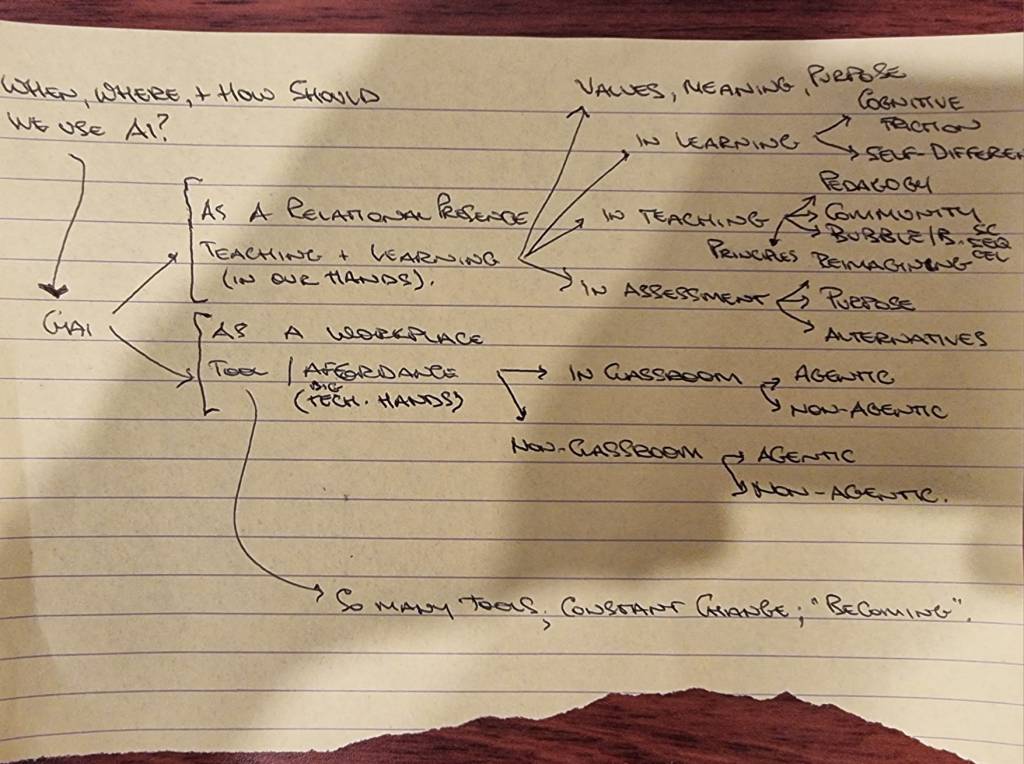
I was writing notes on yellow A4 paper. Nothing special. Just a note-to-self-style stream of consciousness brainstorming of pen on page. I was trying to make sense of how AI is showing up – arriving – in schools, and what we might do about it without getting swept along by the noise.
Halfway down the page I noticed something I hadn’t planned.
My thinking had forked into two directions, lanes, streams. Two paths emerged. And because the paper was yellow – a happy coincidence – I thought of Robert Frost.
Two roads diverged in a yellow wood
Frost’s fork, and ours
Frost wrote The Road Not Taken around 1915 and published it in 1916. A traveller reaches a fork in a forest path. He pauses, looks, weighs up his options, and notes that while one appears “less worn”, both are “really about the same”.
He chooses one, knowing he may never return to explore the other… and wished that he might have traveled “both”.
The poem is often read as a celebration of individuality. But I think it is also a meditation on uncertainty and the stories we tell ourselves later – when consequences are clearer than they were at the fork.
The road we choose makes “all the difference”. That’s the line that snagged me. Because in the AI moment, schools are at a fork in the road too.
A fork we keep arriving at, in meetings, policies, curriculum planning, assessment design, and casual staffroom talk. And some forks are like that. You can’t always “circle back” and undo the route you’ve normalised.
Life offers second chances – but our choices carry consequences and set a course for the future.
Yet knowing how way leads on to way,
I doubted if I should ever come back.
The two diverging roads I can see in schools
I dislike a simplistic dichotomy so am aware of that I am being a little self-contradictory here BUT, certainly, on my yellow page, two “roads” emerged.
The first…
The first is the road most schools can see clearly because it’s already taking shape in front of us. It treats AI as digital practice. Tool-based. Platform-based. A conversation about what’s allowed, what’s safe, and what we will “use”.
That road matters. You can’t lead a school without addressing it… yet we have seen some way down this road before.
And be one traveler, long I stood
And looked down one as far as I could
To where it bent in the undergrowth
It’s also the road most easily paved for teachers by others. It is the road most traveled. It’s a road with some very clear limitations. Once the conversation becomes “tools”, it becomes “products”. Once it becomes about what the “products” or “tools” can do rather than about the learning students, the pace is too often set by vendors, consultants, and the broader ecosystem of ‘big tech’.
When someone else paves the road, they don’t just make it smoother. They decide where it leads.
The other…
The second road is harder to see because it isn’t being paved by external hands. Perhaps it’s “grassy” and wants for “wear”. It treats AI as a shift in professional practice. A pedagogical disruption. A change that forces us to rethink teaching, learning, and assessment.
This lane doesn’t come with a rollout plan. It doesn’t scale neatly. It asks for teacher judgement and localised, relational work.
It is slower. It is less traveled by. But it is also more aligned with what I value and seek to prioritise in teaching.
Why can’t we have both?
Remember, before I choose one road over the other in the next section. Frost see merit in both roads in the yellow wood.
Two roads diverged in a yellow wood,
And sorry I could not travel both
And be one traveler, long I stood…
We need both roads. More than one thing can be true at the same time. There is a need to focus attention on the digital practices / ‘AI as tool’ dimension as well as to focus on professional practice / AI within subject-specific pedagogy dimension.
Road One: the well-marked, freshly-paved route
The digital practice road is appealing because it promises order. It gives schools something tangible to do. Training and support. Guidance. Scalability. Approved tools. Professional learning on features. A sense of control in a fast-moving space. A plan. It also can offer very real and immediate support for students and teachers who urgently need it.
But it’s also the road that “big tech” can own. Road One can be a toll road that may prove expensive in many ways.
The big corporates are good at building such roads. They are good at making tech platforms wide, smooth, and easy to enter. They’re good at keep you on these chosen roads. We rely on their roads. But these are roads designed for business, for corporate clients, for delivery, for solution delivery, for answers, for responses. But are they roads designed for deep learning? Roads for rich relational presence? For taking time to sit uncomfortably? For struggle?
The danger, to me, is clear.
As the corporate controlled AI-in-education road is being rapidly paved to smooth entry by schools, systems, teachers and students, the learning ecosystem changes around it. What is currently an optional path may soon become the default route. Off-ramps from corporate-designed AI-for-learning roads may begin to look like inefficiencies, divergences, distractions… errors.
Cognitive friction is slow and messy. Relationships are messy and difficult. Both are necessary within the learning process.
If we are to engage with corporate AI platforms, as we increasingly are in schools, we need to be aware of Big Tech’s ability and tendency to flatten the experience of learning and to pave over the slow, messy, risky ‘potholes and bumps’ of deep learning experiences. To smooth away the cognitive frictions, the struggles and the challenges. To pave over uncomfortable the landscape of learning.
By building the road, corporate interests can effectively build the default map for schools and what teachers and students do. In doing so, they have the ability to choose both the destination and the route. Not enough teachers are engaging in this space. I’d urge teachers to engage with technology thoughtfully and reflectively. To research deeply and to critique the AI tools presented for our use from a standpoint of pedagogy.
The large tech companies are not (generally, hopefully) acting maliciously. They are acting in accordance with the wishes and goals of their shareholders and governance. Many believe that they are acting in the service of studentsd and teachers. That said, we must remember that their goals are ultimately commercial – not educational. While commercial and educational goals may align at times, teachers need to be alert to the differences. We also need to be alert to the idea that ‘big tech’ do not have all the answers – especially around learning and teaching. (See Why Sal Khan is rethinking how AI will change schools – Chalkbeat)
Maslow’s Hammer
Abraham Maslow in 1966 illustrated the concept of cognitive bias that is known as the law of the instrument (or Maslow’s hammer) by stating: “I suppose it is tempting, if the only tool you have is a hammer, to treat everything as if it were a nail.” He warned that people tend to overuse familiar tools or approaches, applying them to situations where they may not be appropriate.
Corporates will think like corporates.
They are not familiar with the world of education. That is not their world.
Their road designs may not always be appropriate to the world of learning.
Currently, their road is under construction, without line markings, and is being designed and developed by non-teachers.
Teachers need to have courage to diverge from the corporate road being paved for us. While corporate provided roads have affordances, I suspect that they will never take us everywhere we need to go or everywhere we should go.
Teachers should use the affordance of AI tool but MUST play a more active role in paving their own road by using AI in ways that enrich learning.
I shall be telling this with a sigh
Somewhere ages and ages hence:
Two roads diverged in a wood, and I—
I took the one less traveled by,
And that has made all the difference.
Road Two: the teacher-made path through the undergrowth
The professional practice road begins with values, meaning, and purpose. It asks what we want learning to feel like in an AI-saturated world. It is grounded in conversations around pedagogy and practice.
I’m watching how easily AI can smooth away the very difficulty students need in order to grow. It can remove bumps in the road so effectively that students, and teachers, may not even notice the struggle what has been outsourced. They still feel busy. They still feel productive. But the learning has thinned.
Where do we want cognitive friction – the productive struggle that grows capability – rather than frictionless output that looks successful but is actually thin?
This is where my slow teaching instincts kick in. In a VUCA world, the temptation is to reach for certainty, for conclusion, for clarity. The disruption and acceleration we feel in the educational space can lead to the assumption that more tools, more outputs, more frameworks, and more in-built affordances equates to more effective learning. But my lived experience keeps tugging me back towards the importance of relationships, presence and purpose – towards designing learning experiences that make space for thinking.
I’m not looking for ‘click on’. I’m looking for ‘sit with’.
Let’s be clear. The second road is not anti-technology. It’s pro-teacher professional engagement and judgement.
It is a road where teachers remain authors of pedagogy, not simply users of corporate developed tools… and I fear it’s becoming the road less traveled by.
I took the one less traveled by,
And that has made all the difference.
The “sigh”, the “yellow”, and what gets paved over
Frost’s reflective final lines are thought-provoking.
I shall be telling this with a sigh
Somewhere ages and ages hence
That “sigh” isn’t melodrama. It’s the long view. It’s the recognition that the consequences of choices gather weight over time, and that reflection sometimes arrives too late to change outcomes.
I can imagine that sigh in education. The ‘we didn’t notice what we had until it was gone’ vibe. And as if the universe wanted to lean in, my mind went from Frost’s yellow wood to a yellow warning- this time via Spotify after leaving a meeting about AI and pedagogy.
Joni Mitchell captures a truth about loss in her song Big Yellow Taxi that lands uncomfortably well here:
Don’t it always seem to go
That you don’t know what you’ve got
Till it’s gone
They paved paradise
And put up a parking lot
I’m not mounting an argument against technology. Nor am I arguing that we should spurn all involvement by Big Tech in our educational endeavours.
I am mounting an argument against sleepwalking into our future and against handing over educational decision making to non-educators.
As paving is done on roads, we put up big yellow signs. As cautions. As guidance. To give the traveler agency over their circumstances and control over their journey. In a sense, this post is a big yellow caution sign.
There’s roadwork going on. Adjust how you engage with the conditions of your journey.
Paving roads is important work. Paving makes movement faster. Paving gives accessibility. Paving builds efficiency. Paving speeds delivery.
But it also changes what can grow and where it can grow.
It changes what is noticed.
It changes what is valued.
It changes the traveler and the experience of traveling.
Education is an ecosystem. If we let others pave the roads across the learning landscape for us, we shouldn’t be surprised if the ecosystem reshapes itself around their priorities. If we, as teachers, are uncomfortable with that, we need to get involved in informed, reflective ways.
If we do, then, ages hence, the sigh might be one of satisfaction at a job well done.

An After-thought: Values as the only stable reference point
The only constant is change. The tools will keep changing. The interfaces will improve.
The promises will multiply. In that kind of churn, the only constant reference point we have are our values.
What do we believe schooling is for?
What do we refuse to outsource?
What do we think a young person deserves from their education, beyond credentialing and performance?
If we can’t answer those questions, we will default to whatever is easiest to implement. That may well be something provided for us.
And “easy to implement” is not the same as “worth doing”.
Frost’s poem offers teachers, school leaders, and administrators a reminder.
It remind us that we have permission to pause and reflect at critical junctures and that our decisions at the forks in the road matter and have lasting consequence.
We need to resist decisions made on the fly and to act with wisdom and courage.
Because some choices are not easily reversible.
And if the dominant path in AI for education is the one being paved for teachers by people who don’t get learning and teaching, then perhaps we need to take the road less traveled by.
Perhaps that’s a road of teachers own making – a road that not enough teachers are considering or walking on. A road where we walk “in leaves no step had trodden black” that helps us teach for what we value most in humanity.


You must be logged in to post a comment.