
Neat rows. Evenly spaced. Silence. A singular way of working. The teacher’s desk as a command post. One size fits all.
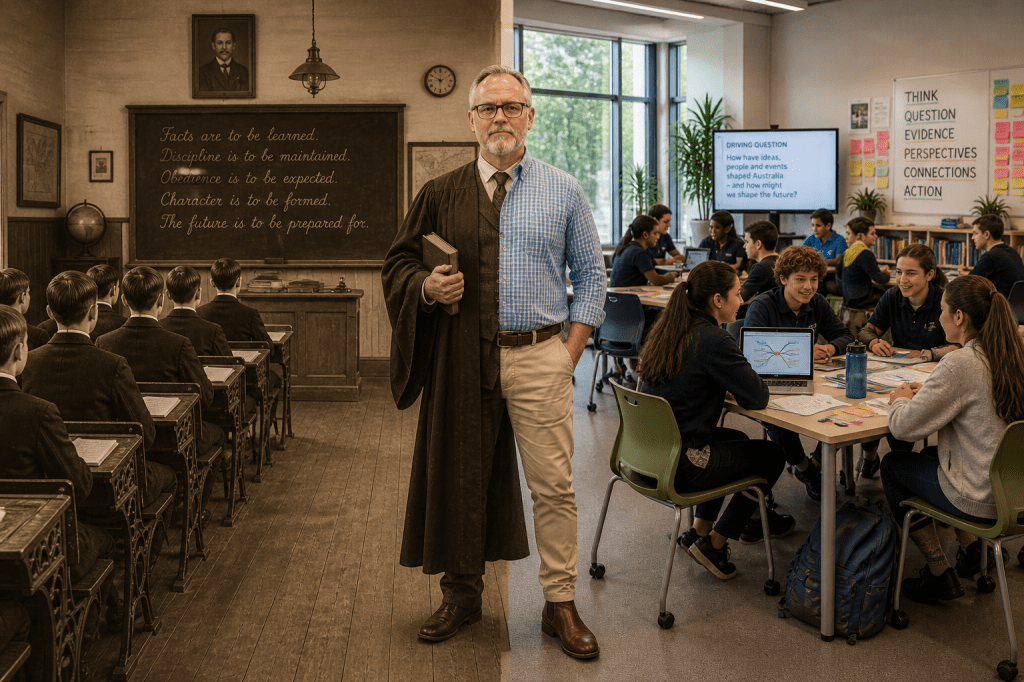
For more than a century, the default classroom has looked like a small factory floor – built for mass-production, efficiency, supervision, and standardised output.
When I started teaching in the 1980s, I discovered something telling. While there were plenty of ‘radical new’ schools trying something different to that, where I started teaching, it was still considered “innovative” to simply move desks out of rows, into groupings of 3. I realised that almost every other class in the school I worked in was set in rows for standardised teaching. That discovery still matters. It reveals a truth we often forget:
Classroom design doesn’t just reflect how we think about learning. It reinforces it.
If AI is shifting paradigms in schooling, then the physical classroom can’t remain an afterthought. We need to revisit design – not to chase novelty, but to protect and amplify what schools are uniquely for.
Classrooms will likely continue. So the room has to earn its keep.
Every so often someone predicts the end of the classroom. But classrooms, as the most common ‘gathering place’ in schools, persist for many reasons.
School classrooms are one of the few places in our society where young people regularly come together across difference – background, belief, temperament, capacity, and aspiration. That gathering together is important. It is foundational to learning and to civic life.
And I’m increasingly convinced that the ‘classroom space’ will be even more important in an AI era of K–12 education.
Because AI can pull learning in a more individualised direction – private pathways, personalised outputs, solitary interactions with an AI study buddy tool, and whether we celebrate that or worry about that reality, I suspect that high quality learning experiences will be those that blend the individula with the communal. In the AI age, the classroom might be reimagined but it will exist.
To serve its purpose, however, it must become more a more deliberately relational space. It must become a place of connection, collaboration, and citizenship.
The factory floor we inherited
As Pink Floyd’s dark imagery reminds us, the experience and architecture of modern schooling schools has origins in another era. The typical school is an artefact of the 19th century industrial work. Teachers and managers. Students as products to be processed. Year levels as conveyor belts. Uniform and dehumanising. This was not a system constructed for differentiation and individualisation.
While we (hopefully) have come some distance from the darkest metaphors that we might associate with Industrial Revolution education, the classic “rows facing front” classroom remains in many respects a physical expression of an industrial imagination:
- one voice, many listeners
- standardised pacing
- behaviour management through visibility and control
- learning as individual completion of tasks
- knowledge as delivery
It is a design for compliance, ‘fidelity’ and scale.
Even now, many rooms still quietly assume that teaching is primarily front-of-room transmission. (Ceiling-mounted projectors facing forward are a small remnant reminder of this – architecture telling us what the “main act” is meant to be.)
But AI disrupts that logic.
If access to information, explanation, and drafting is increasingly abundant and accessible at an individual personalised level, then the justification for a factory-floor classroom weakens further. As the process of disintermediation of the teacher accelerates, the justification for a teacher-centric classroom design also weakens.
Which raises, for me, some questions:
- What might classrooms look like in an AI age?
- What should classrooms be designed to do?
Two rooms, one intention
Between 2016 and 2024, I taught in a space that felt like a pedagogical gift. Almost every vertical surface could become a working surface:
- whiteboards across the entire expanse of the room – front and back
- large panes of sheet-glass windows – ceiling to floor almost – along the sides
- a glass door students could write on
- pinboard space above and below the boards
- and external areas that could be used as breakout spaces
It was an excellent room for learning that is visible, iterative, and collaborative. The room didn’t just contain a space where learning happened – the architecture of the room was a ‘participant’ in the learning process.
In 2025–2026, I’m in an older more traditional room. The room was first designed in the 1890s. It’s smaller and less versatile. It has fewer writable surfaces. It has more “front-of-room” DNA.
But we adapt. The verandah and hallway outside become breakout spaces. Desks are still reconfigurable – by me and by students – depending on the task. And I use a lightweight moveable podium as a roaming base for my tablet so I can stand, maintain connection and eye-contact, access what I need, and keep moving. I don’t camp at it. It’s not a command post. It’s simply a practical perch that supports circulation – because the work that matters most happens among students, not in front of them.
AI shifts paradigms – so we must shift the room
AI isn’t just a new tool. It’s a disruptive presence that changes the shape of the learning landscape. If schooling responds by doubling down on the efficiency myths of the industrial classroom – more standardisation, more monitoring, more “managed” pathways – we risk building an AI-enhanced version of the same factory floor. But there is another possibility.
AI can push us to reclaim what classrooms are uniquely capable of doing: forming communities of learning where young people practise the habits of shared civic life – sharing experiences, speaking up, listening, questioning, disagreeing respectfully, revising ideas, finding common ground, negotiating boundaries, and acting with a sense of civic responsibility toward others.
We don’t need a social media platform run by some big-tech billionaire to be our ‘town square’. Classrooms can be those places.
There’s something deeply Deweyan in this.
Democracy and civics are not just topics. They are a practice. And schools are one of the few institutions where students can learn that practice by living it.
So the design brief for an AI age classroom, to me, should not be “more technology”. It should be more community per square metre.
The shared workshop: a better metaphor than the factory floor
When I imagine an AI-era classroom that aligns with those priorities, I don’t picture a futuristic lab. I picture an artist’s studio – a shared workshop. A communal workspace where:
- mentoring happens in the midst of work
- drafts, proofs of concept, incomplete trial-and-error processes, and half-formed ideas are out where everyone can see them
- students learn by watching others attempt, struggle, fall short, revise, refine, and ‘get up and go’ again
- learning takes shape gradually through iteration
- ideas ferment in exchange, community, and critique
Spaces were the room holds memory – traces of thinking that remain visible long enough to revisit and improve… Spaces that contain parts of students’ chains of evidence of learning.
I suspect that’s a different paradigm of schooling for many. Our dominant paradigm is an industrial metaphor: A factory floor is built for fidelity, standardisation and output.
Perhaps the new paradigm might be more closely related to an artist’s workshop. A shared space is built for ‘apprenticeship’, craft, connection, and community.
In an AI age, the shared workshop metaphor matters because it names what we’re protecting: not just outcomes, but civic formation.
What shared-workshop design looks like
1. Works-in-progress must have somewhere to live
Workshops need visible drafts. Classrooms do too. That means prioritising flexible and convenient working surfaces:
- writable walls and glass
- pinboards for evidence trails and evolving arguments
- portable boards that can travel to groups
- space for thinking to stay up long enough to be genuinely revised
When thinking stays visible, learning becomes less performative and more developmental. Students experience knowledge as something they shape, not something they receive.
2. The room needs zones for different kinds of togetherness
A shared workshop has rhythms: solo concentration, small-group making, whole-group critique. So should a classroom:
- a circle for dialogue and critique
- tables for collaborative inquiry and drafting
- quieter corners for reading and careful composition
- breakout thresholds – verandahs, corridors, outdoor edges – where small-group thinking can breathe
This isn’t ‘flexible seating’ as décor. It’s social architecture.
3. Movement must be normal
In workshops, people move. They step back. Lean in. Compare. Confer. Re-group. Return to revise.
Movement isn’t a break from learning. It’s often how learning becomes social and how ideas become tangible.
4. Furniture must be reconfigurable without drama
If collaboration matters, then desks must move as easily as ideas do.
Students should be able to reconfigure the room as part of the work: pairs to groups, groups to circle, circle to individual drafting, and back again.
5. The teacher needs to mentor, not anchor
Shared workshops change the teacher’s spatial role. Less ‘foreman”boss. Less overseer. Less manager. More circulating an authoritative mentor:
- noticing misconceptions
- modelling disciplinary moves
- coaching, challenging, championing
- demanding, responding, guiding, correcting
- shaping, steering, channeling
- supporting group dynamics
- keeping the ethical centre of the work in view
Even small choices matter here. A moveable podium doesn’t just hold a device. It supports a posture: present, mobile, attentive.
Why history education makes this urgent
Despite what many might think, History is not primarily a subject of recall. It is a discipline of judgement.
It asks students to interrogate sources, weigh accounts, notice silences, trace cause and consequence, and wrestle with competing narratives. In a world saturated with misinformation and strategic storytelling, those are not merely academic skills. They are civic capacities.
As AI increasingly supercharges the abundance of information with personalised narratives, then history classrooms become even more important as places where students practise the habits of community, of the civic town square’, of democratic thinking.
In the History classroom, our primary goal is not to write a glossary, matches the columns, click the boxes, or fill the space on a drag and drop. It’s not to simply recall the dates and places or to retell a soothing dominant narrative.
Our purpose is tied to the ideals of the Enlightenment. It’s enmeshed with the best aspirations of liberal democracy.
At its core, historical pedagogy is social melioristic. Social meliorism is the philosophical belief that the world can be made better through human effort. It sits comfortably between optimism and pessimism. To a social meliorist, progress isn’t a guarantee or a lucky accident; it is a conscious project that requires intervention, social reform, and scientific inquiry.
The social melioristic foundations of History pedagogy see the subject as generative and reparative. History pedagogy is a pathway to enhancing the civic life of our community. That means our classrooms must be more than places of content transmission. The teacher’s role is to enhance the way our students participate in, contribute to, and share responsibility for the community and society they live in.
In History, we should be teaching our students to ask more than:
- When was it?
- Who was it?
- Where was it?
- What happened?
In history, therefore, perhaps we should challenge them to be more by helping them to ask questions such as:
- What is wise?
- What is just?
- What’s the evidence underpinning claims?
- Whose voices are missing in the civic discourse?
- What – and whose – interests are served by the narratives we tell?
- What would a more full and inclusive account require?
- How can I learn from the study of History in ways that enable me to act for the betterment of society?
- How might play a part in rectifying historic wrongs and injustices?
That kind of learning rarely thrives on a factory floor.
It thrives in a shared workshop – where thinking is visible, contested, revised, and held in community.
A closing question
I have a strong suspicion that those who see AI as a ‘tool’, those with a vested interest in selling products to schools, and those who don’t really understand the deeper social melioristic purposes of K-12 schools will tempt educational authorities, school leaders and teachers with promises that AI will optimise, individualise, and offer efficiencies. They will present the cases for data, and tracking, and intervention, and ‘science’… they will offer a path to a technological future of ‘tutor bots’ and ‘customisable feedback’. Many already offer this vision of the future of schools.
That might sound modern.
But it risks drifting back toward a ‘familiar old’; to the monitorialism of the industrial models that have so dominated the past: learning as product, students as units, classrooms as output systems.
If we want something better – more humane, more democratic, more connected – then we need to reimagine schools. That will mean revisiting classroom designs with fresh eyes and seriousness. It may require school leaders challenging architects and building teams to think outside the box. Some schools are already doing this well.
Because rooms shape relationships.
And relationships shape learning.
Relationships are the foundation stones of community and civic life.
So here’s the question I’m sitting with:
If AI is shifting our educational paradigms, why not redesign classrooms towards achieving goals beyond the factory floor – towards becoming places that are workshops for connection, community, collaboration, and citizenship?
 Disrupted History
You must be logged in to post a comment.