
Bindaay-girr yam
Marraal juuda-ndi
darruy guunuwaygu
“We can work together to build a world worth living in”
(Muurrbay Language)
Kindly gifted to the Castlereagh Statement by the Muurrbay Aboriginal Language and Culture Co-Operative
On 26 August 2025, an email landed in my inbox inviting me to take part in a Future of Australian Education in the Era of AI Summit in Sydney – organised by Jason Lodge, Danny Liu, and Katie Ford.
The Summit took place over two days in October. It involved leaders and experts coming together from across the range of Australian educational sectors as well as industry, the arts, and government. All present had come together due to a shared sense that the ground is shifting under schools, universities, training, industry – and under the very idea of what it means to be “educated” in an age of generative AI.
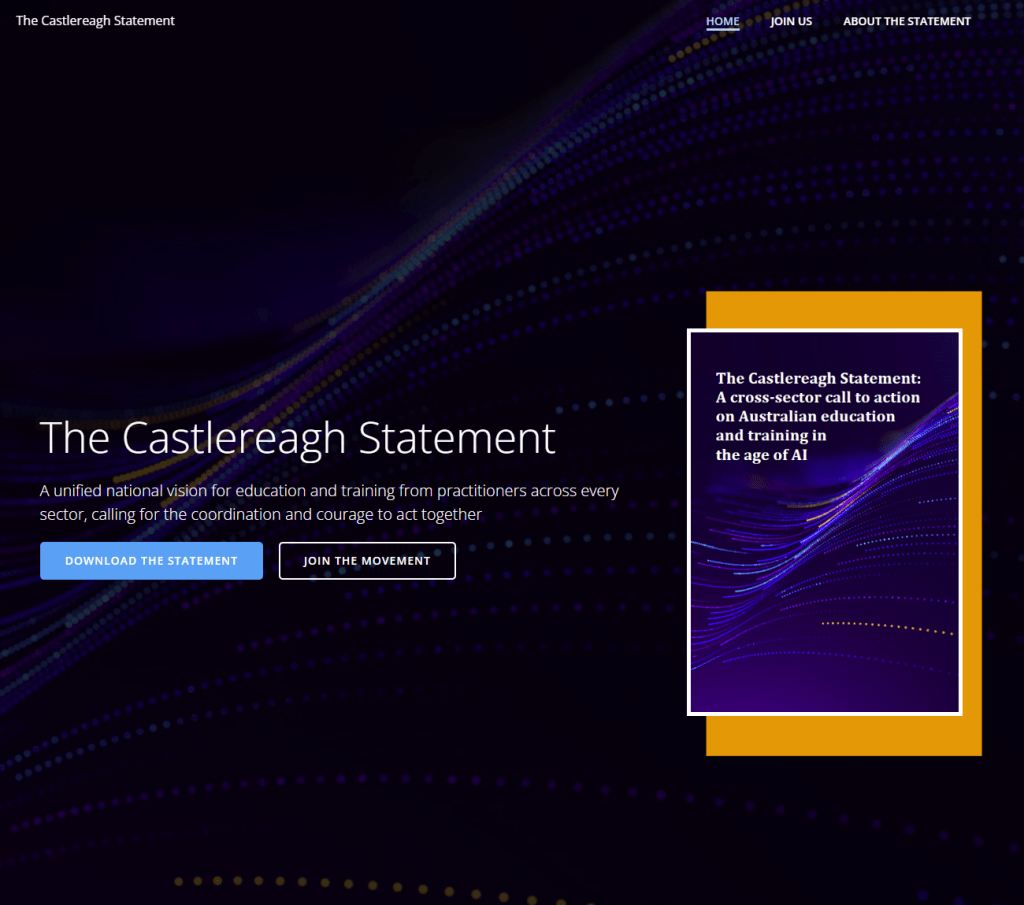
What emerged from that summit is now public: The Castlereagh Statement.
Please give the Statement some of your attention.
Not because it claims to have “all the answers” to the challenges of how Australian education might respond to the era of AI that we find ourselves in. But because it offers something I think we’ve been lacking: a coherent national direction – built by practitioners – that invites the rest of us to help build the path.
The Statement itself describes this beautifully:
“The Castlereagh Statement is a compass, not a map.”
What is the Castlereagh Statement?
The Castlereagh Statement is a cross-sector call to action on Australian education and training in the age of AI – a unified vision that argues we need coordination and collective courage, not disconnected pilots and policy fragments.
It’s explicitly presented as a green paper – a starting point for discussion:
- it sets three goals
- underpinned by six foundational principles
- and proposes a three-horizon framework for action
- while not pretending to pre-design the full architecture of reform (that part of the journey must be taken together).
Who shaped it? Who put their name to it?
The Statement was shaped by “more than 80 educators, leaders, and students from over 30 Australian organisations” spanning schools, VET, universities, government, industry, and the arts.
It emerged from a national summit in October 2025 hosted by the University of Sydney at its Castlereagh Street campus, bringing together people from across those sectors.
The Statement (available via the website or provided below) lists contributors by name (and role/organisation), including representatives from (among many others):
- The University of Sydney, The University of Queensland, The University of Melbourne, Monash, UTS, QUT, Macquarie, Deakin, Griffith, Swinburne, Victoria University, Charles Sturt, Curtin, Adelaide University
- Education Services Australia (ESA) and school leaders from a range of systems and schools
- Business Council of Australia, Microsoft Australia, Adobe, LinkedIn, professional/accreditation bodies (e.g. Engineers Australia) and others
It’s also clear (and important) that contributors are named in their personal and professionally informed capacities, not as official representatives that speak on behalf of their organisations.
The three core ideas at the heart of it
The Statement’s central ideas are framed simply and powerfully:
- Value what matters — agree nationally on what we value in human learners and educators, and align measurement and incentives to reinforce it.
- Connect the journey — build coherent learning pathways from early childhood to lifelong learning, recognised across sectors.
- Equip every Australian — ensure every Australian can engage with AI confidently, critically, and creatively, with human flourishing (not technology) at the centre.
That last phrase matters. It’s not just rhetoric. It’s a line in the sand.
Six foundational principles
The Statement frames the response as needing a shared set of principles to guide a unified national approach, including (in summary):
- redefining the “future-ready” and “educated” Australian
- humility (institutional and individual)
- reconceptualising learning and assessment
- building agile and capability-focused curriculum
- empowering teachers and redefining teaching
- placing technology in the service of pedagogy and trust
What it proposes for Australian schools across three horizons
Here’s where K–12 readers should lean in. In Appendix B, the Statement outlines “Proposed actions for schools” across three horizons:
- Near horizon – urgent stabilisation
- Medium horizon – necessary structural transitions
- Far horizon – new foundations
It groups proposals under Learners and learning, Curriculum, Teachers and teaching, and Technology.
Near horizon: urgent stabilisation (what we need to do now)
A few proposals that stand out:
- Phase out AI detection and unhelpful integrity framing, shifting towards responsible and effective use of AI.
- Redesign assessment guidelines to measure and reward the process of learning, not just the output.
- Build teacher familiarity with responsible AI use, develop cross-school communities of practice, and make AI competency training accessible.
- Strengthen national standards for safeguarding AI use in schools, while addressing equity of access.
Medium horizon: necessary structural transitions (what we must do next)
The proposals become more structural:
- Run experiments where students demonstrate capability through curated, longitudinal evidence — including both AI-supported and AI-independent work.
- Begin actively removing redundant or outdated curriculum elements and embedding learner dispositions and skills more explicitly.
- Provide resourcing (time and funding) for practitioner inquiry and innovation, not just top-down compliance.
Far horizon: new foundations (the school system we’re growing toward)
The horizon language is deliberately future-facing:
- Restructure schooling so students can pursue pathways aligned with interests, alongside shared responsibility with families and communities for developing judgement and discernment.
- Reorient post-school transition criteria beyond a single entry score, so schools can focus on what matters rather than teaching to the test.
- Redefine teaching around what matters because of AI: relational work, identity, purpose, metacognition — the deeply human centre.
In other words: this is not “AI in schools”. It’s a bid to rethink what schools are for.
A practical invitation: “Join the movement”
The site is explicit that this only works if the wider profession shows up:
- sign on
- share what it means in your context
- name what’s missing
- register your interest in shaping what comes next (including sector-specific action plans and a white paper).
If you’re reading this as a classroom teacher, a curriculum leader, a school executive, or someone working in systems… you’re not being asked to clap from the sidelines.
You’re being asked to add your voice.
 Disrupted History
You must be logged in to post a comment.