
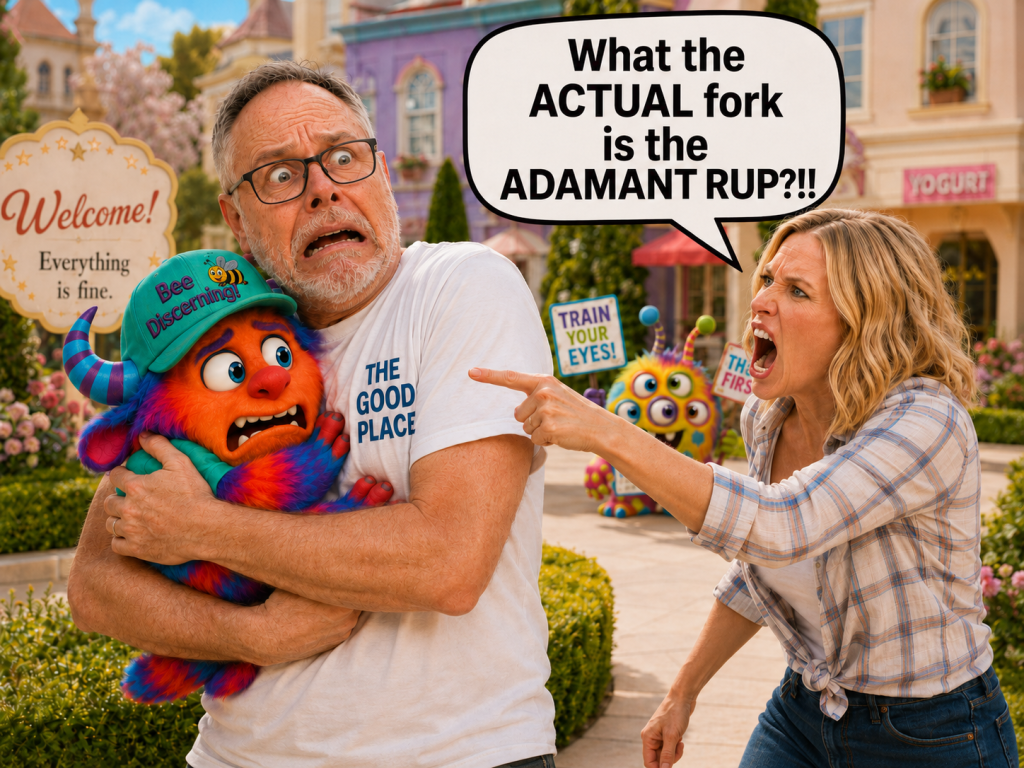
I work with a little monster in my classroom called the ADAMANT RUP. You many know their older sibling, ADAMANT. This little monster is a classroom mnemonic that helps students enter a source with discernment and discipline (not as a box-ticking checklist). This is a quick explainer of my thinking.
Because acronyms are a bit confusing, I’ve employed the help of an AI-generated Eleanor Shellstrop. Hopefully, she’ll help a few teachers to get to the real good place in our classroom!
First things first! What the fork is ADAMANT?
The ADAMANT mnemonic seems to have emerged from the late 1990s and early 2000s in line with the arrival of the historical thinking pedagogy pioneered by Seixas and others. The mnemonic began appearing in teacher-training handbooks and classroom resource banks (such as School History and TES Resources) in the early 2000s. It was designed to simplify the complex process of “Source Utility and Reliability” for GCSE and A-Level students in the UK. Its rise coincides with the influence of the Schools History Project (SHP), which moved away from rote memorisation and toward analyzing the “Nature, Origin, and Purpose” (NOP) of sources. ADAMANT is essentially an expanded, more granular version of the older NOP or TAMER (Type, Author, Motive, Era, Reliability) frameworks. I’ve added RUP for my students in line with Queensland curriculum requirements to explicitly address the reliability and usefulness of, as well as the perspectives in sources. It’s a sibling of the IOP CAM used by Michael Cocks (History Skills) but it’s worth recalling:
No acronym is the ‘magic potion’ for perfect grades*. They are only a tool which can be used to help guide students. High-achieving students will get the most out of IOP CAM when they know when to use each skill most appropriately within the context of their assessment task. | * source analysis – VW edit
ADAMANT is a mnemonic for source evaluation:
A — Author: Who created it? What position, expertise, limitations, bias?
D — Date: When was it produced? Contemporary? Retrospective? Revisionist?
A — Audience: Who was it for? Public? Private? A specific group?
M — Message: What is it actually saying (or implying)?
A — Agenda: Why was it made? Inform? persuade? justify? distract? deceive?
N — Nature: What type of source is it? Diary, speech, cartoon, law, photograph?
T — Techniques: How is meaning delivered? Language, tone, symbolism, omission, framing.
While the ADAMANT acronym is modern, the logic behind it is rooted in Diplomatics, the scholarly discipline of analysing documents that dates back to Jean Mabillon’s De Re Diplomatica (1681). Mabillon established the first formal methods for determining the authenticity and reliability of medieval charters by looking at “Nature” and “Author.” Particularly interesting is Liber III (Book 3) where Mabillon moves from the physical “Nature” of the document (inks, seals, and paper) to the “Internal” evidence – analysing the style, vocabulary, and signatures to determine if the “Author” and “Date” match the “Message” of the text. This is basically the 17th-century precursor to our modern historical source criticism.
Sure, but explain yourself! WTAF is the ADAMANT RUP?
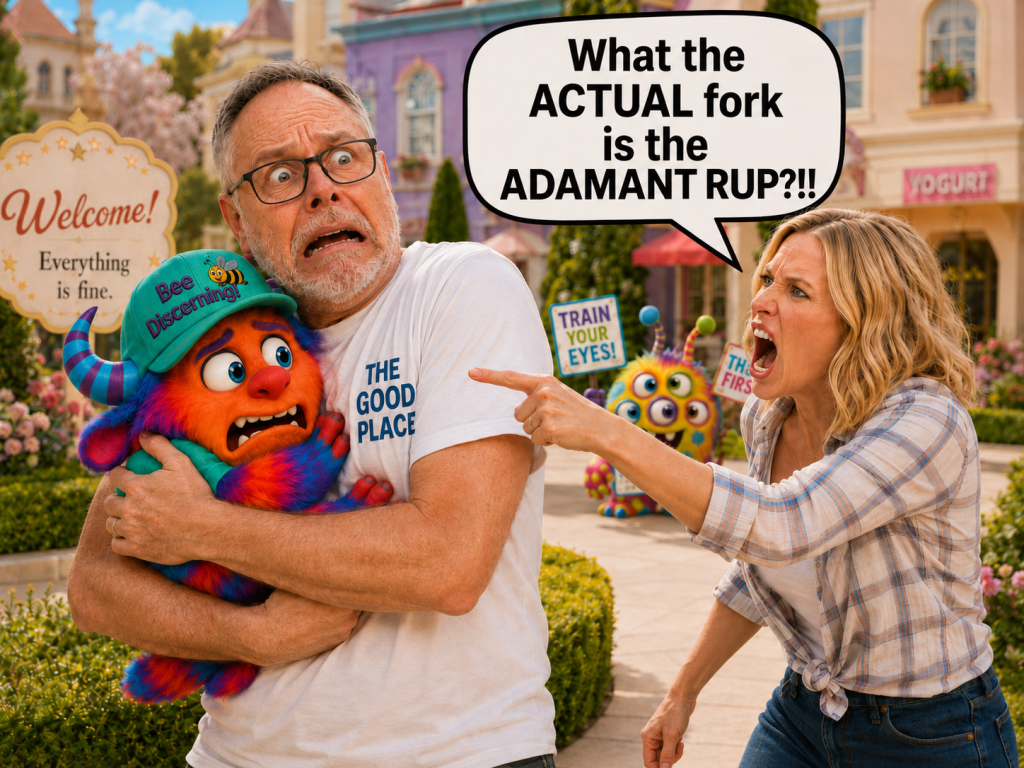
ADAMANT has served me well for years because it slows students down. It nudges them from the surface features of a source toward the deeper work of interpretation.
What makes it work in real classrooms is its function as a menu for identification and consideration of key ideas and features during interrogations of historical sources. It moves students from the overt and obvious describable features of sources toward deeper interpretive judgements. In other words: it nudges students away from description of sources and hot takes towards historical thinking.
But in Queensland – and increasingly across Australia – slowing down isn’t enough. The QCAA syllabi ask students to be explicit about three things that ADAMANT sometimes leaves implied:
- R — Reliability: How much can we trust this source?
- U — Usefulness: How helpful is it for this particular inquiry?
- P — Perspective: Whose worldview is shaping what we’re seeing — and who is missing?
I think these elements are especially important in an age of AI generated content.
That’s where RUP comes in.
It’s an extension oF ADAMANT that makes the end point of source evaluation clearer – especially for students working in high-stakes assessment contexts.
RUP turns analysis into judgement (without rushing it)
What I like about adding RUP is that it asks students to earn their judgement, rather than defaulting to quick labels like “biased” or “propaganda”.
Reliability asks:
- What claims can be verified elsewhere?
- What limitations (time, access, motive, expertise) might distort accuracy?
- Where is this source strong, and where does it wobble?
Usefulness asks:
- Useful for what purpose, in what context. and for who, exactly?
- Does it illuminate causes, experiences, decisions, impacts, values?
- Is it better for understanding attitudes than events – or vice versa?
Perspective asks:
- What beliefs, values, or assumptions sit underneath the words and images?
- Who benefits from this framing?
- Who is silenced, excluded, or rendered invisible?
“Bee Discerning: Don’t mistake the pathway for the destination
Here’s the trap I keep seeing with mnemonics. When we give students a mnemonic, they can treat it like a prescriptive to-do list: tick the boxes, write the sentences, move on. But ADAMANT–RUP isn’t a checklist. It’s a way in.
It’s a set of prompts that helps students enter a source with curiosity and care – not the place you’re meant to land. The scaffold is a starting point, not an end point
A good historian doesn’t ask every question with the same weight, every time.
They ask what the source demands.
Sometimes students should emphasise only a few elements:
- A private diary might make Audience almost irrelevant, but make Perspective essential.
- A government poster might fuse Agenda, Techniques, and Message into the same conversation.
- A photograph might require you to think about Nature (what kind of image is it?) and Techniques (cropping, staging, symbolism) at the same time.
Being discerning means you’re allowed to say:
- “This bit matters a lot here.”
- “That bit matters less.”
- “These two belong together.”
- “Something important sits outside the mnemonic.”
It’s important to teach students to blend, flex, and notice what the scaffold misses. Real analysis is rarely neat.
I’ve notices that, often:
- Author and Perspective travel together – but the “author” might be more complex than it first appears. Is the author actually an artist? The publisher? The editor? The government department? Sometime else – perhaps an algorithm that curated it? Can AI generated text truly have an author as we understand it?
- Date isn’t just a timestamp. It can be an invitation into wider context – what came before, what followed, and why this moment mattered.
“Date” is just a starting point. Looking at the “date” of a source is often really about context and perhaps about historical significance. (And maybe the date of publication for a secondary source isn’t worth mentioning at all?) - Nature is rarely neutral. The form of a source often is tied to its purpose, its author, and its agenda. A cartoon, a speech, a school text, a meme – each carries built-in constraints and messaging possibilities.
- Techniques are not decorative. They are how power moves through a text or image – shaping the perspective being offered, and the response being sought.
Discernment caps it all off!
So, use ADAMANT–RUP as a compass, not a cage.
Let it guide students’ attention, but don’t let it replace their judgement.
Because the goal isn’t to “do the mnemonic”. The goal is to ask, with growing sophistication:
- What is this source doing?
- How is it doing it?
- What can I responsibly do with it – and what should I be cautious about?
That’s discernment. And that’s the work.
ADAMANT RUP is a tool to help force students to think critically.

 Disrupted History
You must be logged in to post a comment.