
As a history teacher, I have a confession to make.
I work with quite a few little monsters!
To be very clear, I’m not talking about students – or even teachers – here. I’m talking about a quirky set of characters that probably came to me in some sort of pedagogical fever dream!
Regardless of their origin and quirkiness, the little monsters help me to work through a sequenced routine for teaching historical source work. They help me teach for discernment, and inclusive “help” from AI that doesn’t steal the learning from students.
This post will be a bit different in style and tone to others recently. In it I hope to reflect on a classroom routine that I use. It focuses on a strategy for teaching students the skill of interrogating historical sources in an era in which generative AI has become an ever-present form of “easy help” within the classroom.
At the outset, I want to point out that it’s my strong belief that the most useful question for teachers to ask themselves about AI within the teaching and learning process is not whether students should use AI, but how we might sequence and scaffold help so that students remain the primary meaning-makers.
The routine I’m going to share begins with deliberately protected individual and collaborative encounters with an unfamiliar historical source (typically with no student use of internet support and ‘no AI’), and then gradually permits bounded AI use as a “study buddy” and research support. Essentially, as students demonstrate that they have carried enough cognitive load and faced suitable levels of ‘beneficial struggle’, they are allowed to make targeted use of AI support.
As you read this post, it’s important to grapple with the distinctions between what’s been described as beneficial and detrimental cognitive offloading. It’s important also to recognise that I argue learning experiences shouldn’t just be about challenging students but also about supporting them. I want to emphasise that inclusion and accessibility sometimes warrant thoughtful and responsive exceptions to blanket ‘no AI’ rules.
Finally, while this might be a rather long post, I’d like to introduce you to two simple visual cues used in my classroom – the “Think First / Train Your Eyes” and “Be Discerning / the Adamant Rup” little monsters. These little monsters are characters I refer to in my classroom and place into my resources to prompt and guide student critical thinking. These monster ideas are effectively parts of the routine’s design and function as memory anchors to support students’ attention and judgement.
Work the problem: the problem is not AI, but when help arrives
I’ve been teaching long enough to know that students, generally, have always looked for shortcuts. That’s not a criticism; it’s a human trait. The difference now is that the shortcut is sitting on the desk beside them, speaking in fluent paragraphs, offering interpretations with a calm confidence that can feel indistinguishable from authority. Generative AI hasn’t invented “easy help”, but it has made it instantaneous, persuasive, and difficult to resist -particularly for students who have not yet developed the habits of attention and skepticism that historical thinking requires.
In that context, the usual debate – should we allow AI or not? – quickly becomes too blunt, too narrow, and a bit hollow. Surely we’ve moved on? In a real classroom where one-to-one device use is common, the question is more practical and more ethical than that. To me the conversation must be: how do we design learning so students still do the first and hardest part of the work?
If AI becomes the place students’ starting point for learning, I believe that it can quietly replace the very cognitive friction through which understanding forms: noticing, grappling, puzzling, hypothesising, revising, and judging what is plausible.
Yet if we try to eliminate offloading altogether, we risk building ways of working that unintentionally exclude some learners. The challenge is to hold both truths at once.
This is where I find my own “Bubble and Burner” thinking useful.
At its core, it is a framework for teacher regulation of pace, intensity, and knowledge flow – especially the timing of AI assistance. Rather than treating AI as a simple on/off switch, the model invites us to think in sequences: when to withhold, when to permit, when to bound, and when to intensify support -always with the aim of strengthening student agency rather than replacing it.
The routine I’m trying to describe in this post is one concrete example of that sequencing approach. It is not presented as a magic bullet or a one size-fits-all way to work. But it is something that works for me. It is, to me, deliberately staged method for teaching students to work with sources in ways that preserve the integrity of historical thinking while still making space for inclusion, accessibility, and the reality that AI is here.
Two “little monsters” as memory anchors for attention and discernment
In order for a routine like this to take hold, students need more than instructions. They need cues – small prompts that quickly remind them what kind of thinking is required right now.
In my classroom I use simple icons I call the “little monsters”.
The two I refer to this this post appear,at specific stages, alongside the source materials that students are required to engage with. My “little monsters” are cultural markers in the room. They’re quick, memorable, and disarming.
They are playful in appearance, but their purpose is serious: they function as cognitive anchors.
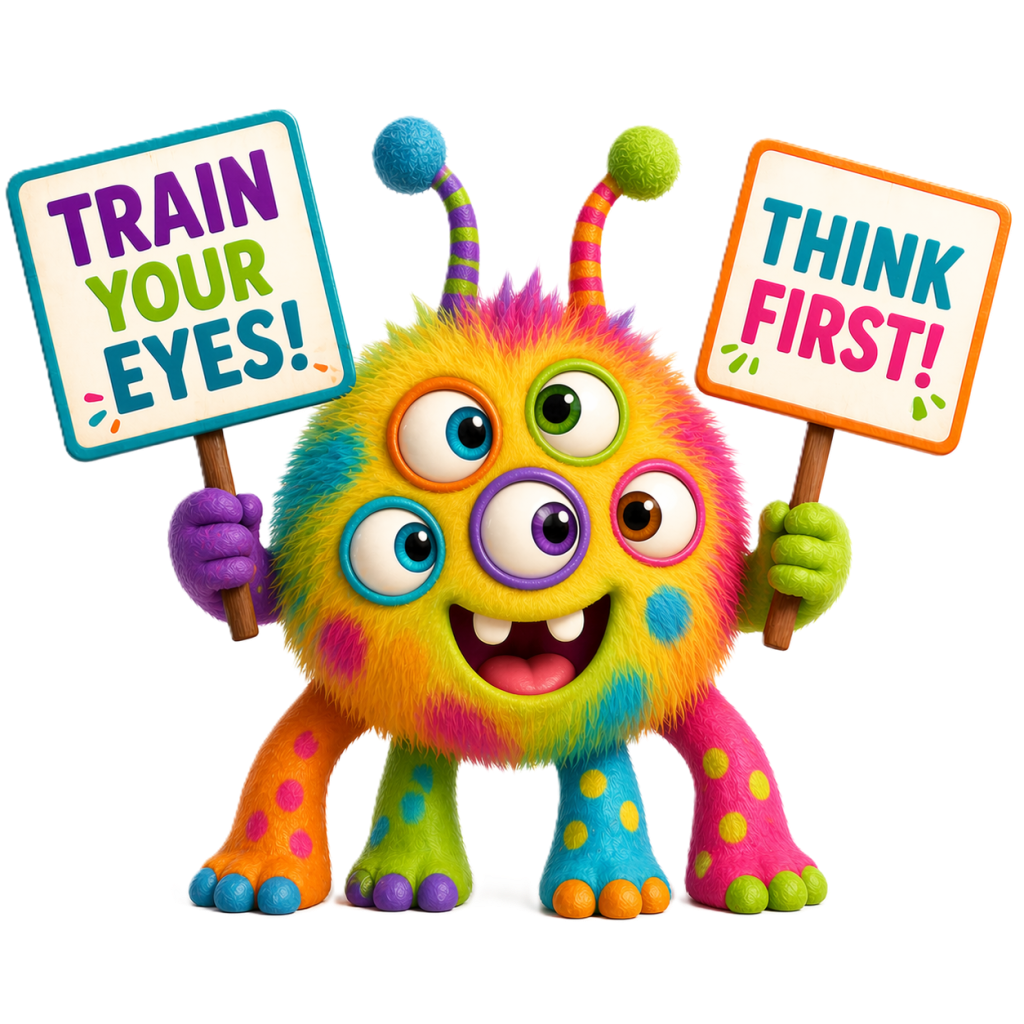
Monster 1: “Think First / Train Your Eyes”
This one sits beside the source at the start. It’s the guardrail. It signals: You don’t get to outsource your first encounter with evidence.
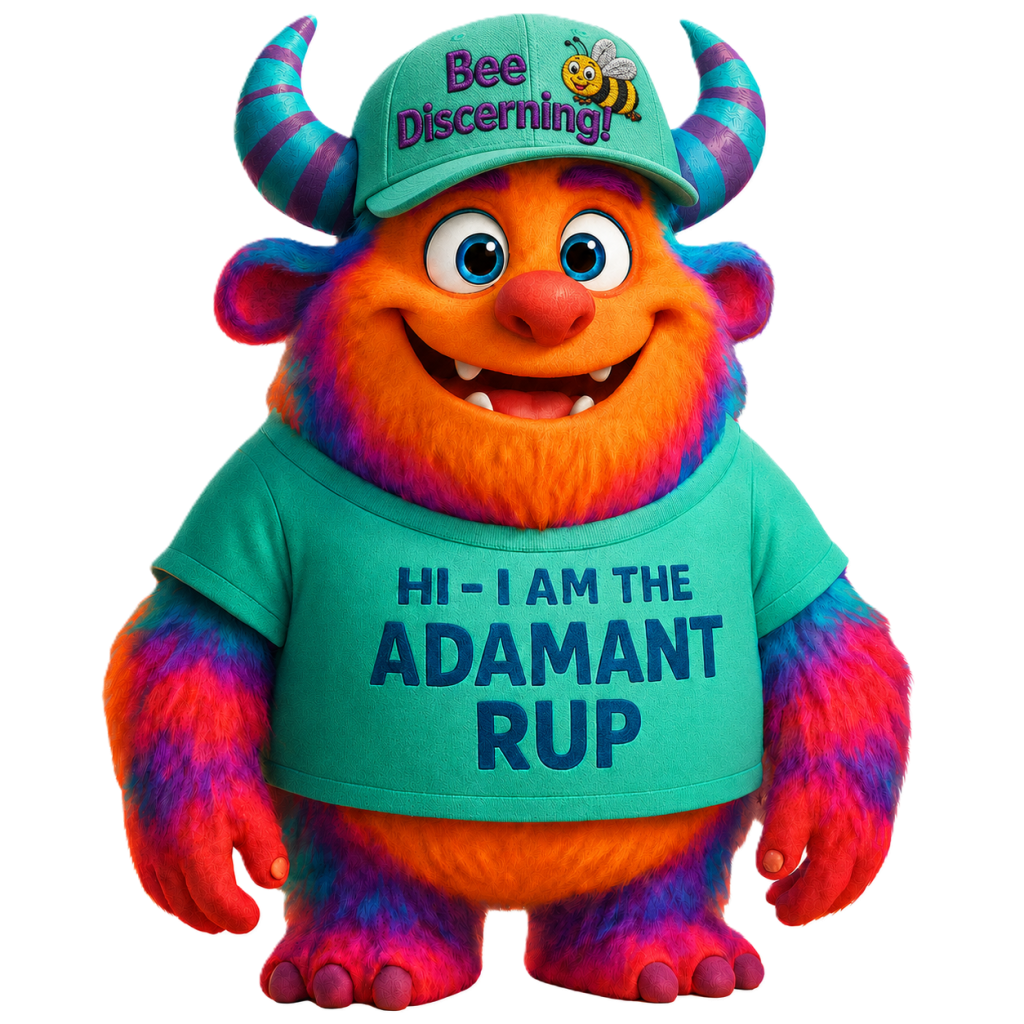
Monster 2: “Bee Discerning” / (ADAMANT RUP)
This one joins later. It signals: Now that you’ve looked, you need to dissect the source material, strip it down to its key features and component parts to uncover meaning, purpose, and historical significance BUT you need to do it thoughtfully. Not in a salvish performative way.
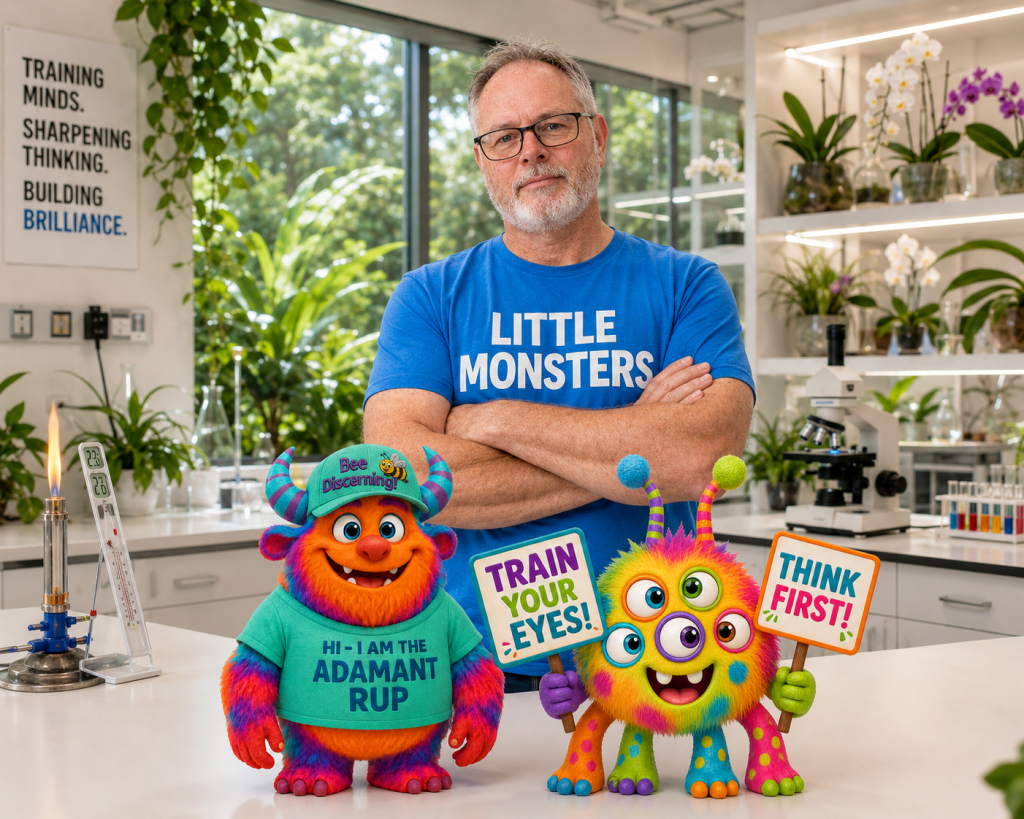
‘Think First’ is a monster of an idea…
The first “little monster” to introduce to you is “Think First / Train Your Eyes.”
It appears at the beginning of the routine, when students encounter an unfamiliar source. Its message is straightforward: begin with your own noticing and tentative interpretation before reaching for external help.
Think First has origins in my recently published research and can be readily linked to the Brain-to-LLM findings of Natalya Kosmyna‘s team at MIT.
For classroom practitioners, the place of AI within their practice is a core concern. The Bubble and Burner Model provides a way to visualize sequencing and scaffolding, with a shared language for discussing cognitive load, fading, and metacognition through the metacognitive principle of Think First. (Full article: The Bubble and Burner model of AI-infusion: a framework for teaching and learning)
Another monster idea is that ‘discernment matters’…
The second little monster I use in my classroom is “Bee Discerning”. It’s now been paired with my ADAMANT RUP mnemonic.
The Bee Discerning little monster reminds students to be reflective, thoughtful and wise as they engage with sources. This little monster generally appears in my classroom practice as students move into deeper analysis and evaluation.
Its message is as important as “Think First”: analysis is not a checklist; it entails judgement and reflection. Students must decide what matters most, what should be included, what is plausible, what is useful, and what can be defended.
Teaching for discernment is crucial when providing students with opportunities to use web-based research, generative AI, or even simple mnemonics. Students, who live and work, in often highly pressurised performative environments often seek quick and easy recipes to ‘achieve grades’.
GAI is best viewed as requiring steering by humans. It responds to the critical thinking, discerning decisions, and creative inputs and prompts of the user. The teacher’s function is to develop students’ capacities for exercising these skills. For every GAI output students must discern the efficacy of their prompts and create subsequent interactions. Students are involved in a reflexive interplay of creation, reflection, discernment, and generation that develops “inquisitiveness [and] intellectual flexibility”… using GAI is structured into a teaching and learning process promoting student voice, discernment, and critical thinking; a process that “promotes active engagement with, rather than
passive acquisition” of content”. (Full article: Generative artificial intelligence in education: Initial principles developed from practitioner reflexive research)
WFT is ADAMANT RUP
I love a good acronym and ADAMANT requires a bit of extra explanation… BUT it’s not the main game in this post. If you want to following in the footsteps of Eleanor Shellstrop by asking “What the fork is ADAMANT?” you can find an explainer here.
Monsters in an AI-infused pedagogy?
These two monsters are not decorative. They are part of a pedagogical approach to teaching in an AI-infused classroom.
They help establish a classroom culture in which students understand that
(1) attention comes before assistance, and
(2) tools, including mnemonics, should not be seen as magic bullets. They are only as good as the discernment with which they are used.
The source interrogation routine: what it is (and what it is not)
What follows is a routine I use repeatedly across Year 8–12 history, with both primary and secondary sources. It is deliberately staged. The sequencing matters because it helps me regulate when students receive help, what kind of help is legitimate, and how much cognitive friction is being preserved. In other words, it operationalises the idea that the question is not “AI or no AI?”, but how we sequence and scaffold help so students remain the primary meaning-makers in their learning.
A few clarifications before the steps:
- This is not a “one-size-fits-all” script. I compress or expand stages depending on the source, the class, and the moment.
- It is also not a purity ritual. “No AI” early is the default because I’m protecting attention and first-pass thinking, but accessibility and inclusion sometimes require exceptions.
- The routine is built around two small classroom cues – my “little monsters”- that act as memory anchors: Think First / Train Your Eyes early, and Bee Discerning (ADAMANT RUP) later.
With that framing in place, here’s the routine.
Step 1: Individual encounter, Think First conditions
Students begin with a historical source they haven’t seen before. I give it to them in OneNote, and they annotate it with a stylus.
At this first stage, I deliberately constrain the conditions: no internet searching, no checking their notes, no background reading, and (in most cases) no AI.
That last constraint isn’t about moral panic or purity. It’s about protecting what I see as a fragile, essential part of historical thinking: the learner’s first encounter with evidence. If students begin with “easy help”, they can miss the cognitive work that matters most – learning to notice, to sit with uncertainty, and to make their own provisional sense of what’s in front of them.
This is where the first little monster appears.
Think First / Train Your Eyes sits beside the source as a classroom cue. It signals: start with your own attention and judgement before you reach outward for answers.
A key refinement: “context first” before “source first”
A move that surprises some students (and some adults) is that I often ask them not to look at the source itself first. (Often harder than it sounds!)
Instinctively most students want to dive headlong into the source they have been provided. Instead, I direct them to the short context statement I’ve attached – two or three sentences at most, more like an art-gallery caption than a worksheet.
Students are drilled to embed their initial thinking in:
- the context statement (what’s been explicitly provided), and
- the less obvious context of our course—where we are in the unit, what we’ve read, what we’ve discussed, and what I’ve been emphasising as significant.
They know I haven’t chosen the source randomly.
They know it is connected to our current inquiry. Step 1 is where they practise locating the source within that broader frame, before they start trying to interpret every symbol, phrase, or detail.
In a sense, the context statement acts as a stabilising entry point, not a shortcut to an “answer”. It helps students avoid the flailing that can lead to superficial or wildly speculative first readings.
Inclusion matters: “no AI” cannot mean “no access”
I do, however, need to add an important qualification. A blanket “no AI” stance in Step 1 can become unintentionally exclusionary if it prevents some learners from accessing the task. So while Step 1 is generally “no AI”, I make room for accessibility-first supports when their purpose is inclusion rather than cognitive bypass.
For example, there is no reason a student should not use text-to-voice tools to access the context statement or a written source. Likewise, a student with recognised literacy needs may (under teacher guidance) use AI to help unpack the language of the context statement so they can meaningfully enter the task. That sort of support does not remove the core historical thinking, the most important cognitive load. It removes a barrier that would otherwise stop the thinking from happening at all!
This distinction – between beneficial and detrimental cognitive offloading- runs underneath the entire routine. Some offloads increase access and participation. Others steal the very cognitive friction through which understanding forms. The teacher’s work is to hold that line, responsively, student by student, task by task.
The classroom question is always: is this tool removing a barrier so thinking can happen, or removing the thinking itself?
Learning shouldn’t be “easy or hard”. It should be both accessible and challenging so that learning is possible.
Scaffolding a first pass with a little monster
Before students move into the Step 2, there is another significant phase within Step 1. I deliberately bring in Bee Discerning and ADAMANT RUP while students are still working alone.
This matters because I want the mnemonic to function first as a thinking scaffold to aid in analysis of the source rather than a group-driven “division of labour” exercise.
In other words, before collaboration, each student needs to have engaged ina significant cognitive load via a personal, defensible deconstruction of the source before the social negotiation of learning begins.
In this individual phase, I remind students of three things (often explicitly, sometimes with a quick gesture to the little monster I’ve often embedded within their OneNote page):
In this individual phase, I remind students of three things (often explicitly, sometimes with a quick gesture to the monster on the page):
- ADAMANT RUP is a menu, not a checklist. The letters don’t have to be used in order, and you don’t get extra points for “covering” them all. The aim is judgement, not completion.
- Start with the bigger features or ideas within the source. Students are encouraged to identify what is most visually or rhetorically dominant – elements of composition, repeated motifs, central claims, prominent symbols, striking absences – then to label those features and propose plausible meanings. This is where they begin linking to culturally situated knowledge: what the intended audience may have assumed, recognised, or felt in that time and place.
- Choose only the ‘lenses’ of the mnemonic that genuinely help with this source. I will often suggest (especially for novices) that they select two or three elements of ADAMANT RUP that seem most promising and go deeper, rather than trying to skim across everything. For example, a student might lean heavily into the Techniques + Message for a propaganda poster, or Author, Agenda + Audience for a political speech, or Nature + Reliability + Perspective for a secondary account.
This individual “Bee Discerning” pass sets up Step 2 properly.
When students then move into the A3 + Sharpie collaboration work of the next stage, they arrive with initial interpretations in mind that are worth testing, challenging, and revising – rather than outsourcing their individual thinking to the loudest voice at the table.
Step 2: Collaborative interrogation – A3, Sharpies + Bee Discerning in action
After the individual work of Step 1, I ask students to close their OneNotes. That matters. I want the next phase to feel different: more public, more dialogic, and more accountable to other minds in the room. I don’t want students to be so locked in on their own thinking that the conversations that take place are little more than note-swapping exercises!
Students then work with one or two self-selected, trusted peers around the same source, now provided as an A3 paper print-out.
They annotate directly onto the page using Sharpies. The physicality is part of the design. The marks are bolder, harder to erase, and shared. It nudges students towards committing to ideas, but also towards negotiating those ideas with others.
This is where the second little monster again enters the routine: Bee Discerning, paired with ADAMANT RUP.
The reminder here is not “use the mnemonic” slavishly. In my experience, students can easily turn any scaffold into a performative checklist.
The instruction is to use your judgement. The whole point of Bee Discerning is to challenge that habit by making discernment explicit: what matters most in this source, what can we plausibly infer, and what is worth pursuing further? In this collaborative Step 2 of sourcework, students navigate what each person wants to prioritise. They test their ideas and insights against those of a trusted network of fellow learners. They also remind one another that the order of ADAMANT RUP doesn’t matter and that not every element is equally useful. The mnemonic, in our process, is a menu, not a mandate.
This is also where the routine deliberately invites productive friction. Students may disagree. They challenge one another’s inferences. They push back on overreach. Looking at a primary source propaganda poster from 1933 Germany, one student will say, “I think that’s an eagle,” and another will respond, “Maybe – but what makes you say that? What else could it be? What would it mean if it is an eagle?” That kind of conversational testing is exactly the point. It forces students to move beyond “I reckon” and towards “I can justify”.
My role in Step 2 is active but restrained. I circulate as monitor and coach, sometimes as what might be called a “meddler in the middle”, and often as a hint-giver. The hint-giver role is especially powerful in collaborative work because it redirects attention without collapsing the task into teacher-supplied meaning. A hint might be as simple as: “Have you considered the possible religious symbolism in the bird? Would it make sense if it were a dove?” or “Have you noticed the repetition of colours and symbols here – what might that be saying to an audience?” These prompts don’t provide an interpretation; they sharpen the students’ own noticing and keep the intellectual ownership with them.
One further nuance: while Step 2 is generally a “no AI / no research” collaborative phase, I will sometimes allow a small amount of targeted research or AI use during this stage – particularly if the group hits a genuine interpretive bottleneck, or if the source contains language, symbols, or references that are unlikely to yield to observation and discussion alone. When I do this, I usually allow only one student in the group to act as the device-holder. The purpose is to keep the group anchored in shared talk and shared looking, rather than letting the collaboration collapse into three students silently consulting three screens. The device-holder’s role is bounded: they are not there to “find the answer” or import a ready-made interpretation, but to test a specific question the group has already generated (for example, identifying a symbol, translating a phrase, confirming a definition, or checking a basic contextual detail). Used this way, the technology functions as a constrained support inside the thinking process, rather than a replacement for it – an early rehearsal of the discernment students will need when AI use expands later in Step 4.
By the end of Step 2, the A3 sheet usually looks messy – in the best sense. It is a shared artefact of thinking: competing labels, arrows, questions, challenged assumptions, half-formed interpretations. That mess is not a problem to be cleaned up. It is evidence that students have started to do what historical inquiry requires: to interrogate, to weigh, to argue, and to revise.
Step 3: Return to the individual – revision as a discipline
After the noise and negotiation of Step 2, I deliberately bring students back into a quieter, more accountable space. They return to their own OneNote page and reopen their individual annotations from Step 1. They can still see the A3 source their group has worked on, but the task now changes: this is no longer collaborative performance. It is individual revision of ideas.
The purpose of Step 3 is to make students practise a discipline that sits at the heart of historical thinking: revisability. They update, correct, extend, and sometimes abandon early claims. They pull across the best insights from the group work, but they also have to decide what they actually accept and can defend. In other words, students are not copying the group’s conclusions; they are integrating them into a revised personal reading.
This stage also helps prevent a common collaborative pattern: the “loudest voice wins” effect. In Step 2, it’s possible for students to be swept along by the momentum of discussion. Step 3 removes that potential detrimental cognitive offload. Each student has to produce a revised interpretation that reflects:
- what they noticed initially,
- what was challenged or strengthened through dialogue, and
- what now seems most plausible, significant, reliable, or useful.
A key nuance: limited AI and research can occur here (but it stays bounded)
While Step 4 is the point where AI use becomes more explicitly permitted and taught as a “study buddy” routine, I sometimes allow small, carefully bounded use of AI or research in Step 3 as students consolidate their thinking. When I do, it is for very specific purposes: clarifying a term, translating a phrase, checking a basic contextual detail, or testing a question that has already emerged from their own reading and the group discussion.
The constraint is the same one that runs through the whole routine: the tool is not there to generate the interpretation, and it is not there to write the analysis. It is there to support the student’s own meaning-making at the point where they are refining and strengthening what they can already see and argue.
To keep this from becoming a quiet cognitive bypass, I generally hold Step 3 tool use to two expectations: it must be targeted (a specific question, not a broad “explain the source to me”), and it must be transparently identifiable in the notes. Practically, I often prompt students with questions that keep the emphasis on revision rather than decoration:
- What did you miss the first time?
- What did you overreach on?
- What changed your mind, and why?
- What are you still uncertain about?
- What is one thing you want to test later with research or AI—and why?
By the end of Step 3, students should have a stronger, more defensible individual reading than they had at the end of Step 1, precisely because it has been tested socially and then refined privately. Step 4 then builds on this by formalising AI and research use more explicitly, with clearer guardrails and routines.
Step 4: AI and research enter explicitly – bounded “study buddy” use (not outsourced interpretation)
Step 4 is the point in the routine where I name AI use clearly and teach it deliberately, rather than letting it exist as an unspoken “grey zone”.
By now, students have done three things that matter: they have made an initial attempt alone, had their thinking tested socially, and then revised privately. In other words, I’m generally confident that they have likely carried enough cognitive load that the next forms of help are more likely to extend their thinking rather than replace it.
This is why I prefer AI to arrive after Step 3. At this point, students have something to bring to the tool: a developing interpretation, specific uncertainties, a set of competing possibilities, and a clearer sense of what they are trying to work out. That is a very different starting position from “I don’t know what this is – please explain it to me.”
What AI is for in Step 4
In this stage I frame AI (and web-based research) as a bounded support that can help students to:
- test ideas that they’ve already formed
- clarify unfamiliar vocabulary or contextual references
- translate embedded language in a source (where relevant)
- identify or compare symbols, motifs, or rhetorical techniques
- generate alternative interpretations that can then be evaluated
- surface counter-arguments to strengthen judgement
- identify possible alternatives to their thinking
The key is that AI becomes a partner for questioning rather than a producer of finished interpretations.
What AI is not for in Step 4
I’m equally explicit about what crosses the line. AI is not permitted to become:
- a substitute for the student’s own interpretation (“analyse this source for me”)
- a shortcut away from an ‘authoritative reading’ / an alternative high quality source found online
- a way of bypassing the interpretive struggle that the first three steps were designed to cultivate
In other words, Step 4 is not a release of restraint. It is a shift from protected thinking to AI–supported thinking.
Prompting matters: “2 I’s + V” as a discipline
This is also where I weave in the prompting routines students have learned. I encourage them to anchor AI use in two I-statements and a well-directed verb (“2 I’s + V”), so the tool is given context and purpose rather than vague requests for answers.
A Year 10 example (Holocaust / propaganda) might read:
“I am in Year 10 studying the Holocaust, antisemitism, and the rise of the NSDAP. I am analysing a Nazi propaganda poster (1933). I suspect the bird breaking through clouds in rays of light is an eagle, and my teacher has suggested religious imagery and metaphors may be relevant. List five religious-themed artworks with similar imagery that could plausibly be a parallel, and explain what that imagery traditionally symbolises.”
Notice what this does: it makes the student’s prior thinking visible, it directs the tool towards possibilities rather than “the answer”, and it keeps the work of judgement with the student.
Keeping it bounded and visible
To reduce the risk of Step 4 becoming silent outsourcing, I generally keep AI/research use bounded by simple expectations:
- Targeted questions, not broad prompts that invite full replacement interpretations.
- Visible traces in notes: what was asked, what came back, and what the student did with it (accepted, rejected, revised, or parked).
- Where helpful, one device per group (or a designated device-holder), so that research remains a shared support rather than a fragmented set of private, screen-based “answers”.
This is also where “Bee Discerning” continues to matter. AI outputs are fluent, but fluency is not reliability. Students are expected to treat AI responses as provisional: something to be tested against evidence, context, and other sources, not something to be absorbed uncritically.
Accessibility remains part of the story
Finally, Step 4 is often where AI becomes most obviously beneficial for inclusion: translation, vocabulary clarification, rephrasing complex language, and structured tutoring can help students access disciplinary thinking more fully. But the guiding distinction remains unchanged: supports are legitimate when they remove barriers and deepen engagement, and they become detrimental when they remove the thinking the task is designed to develop.
Step 5: Collaboration again — returning to the A3 with notes, findings, and disciplined restraint
Step 5 deliberately repeats the collaborative structure of Step 2, but under different conditions. Students return to their A3 print-out in pairs or trios,
Sharpies in hand, and they bring with them what they’ve developed since the first collaboration: their revised individual notes from Step 3 and any bounded research or AI-supported insights gathered in Step 4 (and, in some cases, in the late moments of Step 2).
This second collaboration is important because it changes the nature of the talk. In Step 2, students are largely negotiating interpretations based on what they can see and infer from the source itself. In Step 5, they are also negotiating what to do with external input. That shift is significant. It is one thing to debate whether a symbol might be best described as religious, nationalistic, or militaristic. It is another thing to decide whether a piece of supporting information actually strengthens that claim – or whether it is a tempting but unreliable tangent.
The “Bee Discerning” cue remains active here. Students are reminded that more information is not automatically better thinking. Their task is not to flood the A3 sheet with extra facts, nor to paste in an AI-generated “explanation” of the source. Their task is to decide what is most relevant and defensible: which insights genuinely illuminate authorial agenda, audience, technique, message, reliability, usefulness, and perspective – and which should be treated cautiously or discarded.
Practically, Step 5 tends to involve three kinds of group moves:
- Confirmation and strengthening: students use research to support a claim they had already begun to form (e.g., confirming a symbol’s conventional meaning, clarifying a historical reference, translating text within the source).
- Correction and recalibration: students identify where early interpretations were overconfident, anachronistic, or simply wrong, and they revise accordingly.
- Refinement and prioritisation: students decide what matters most for the purpose of the task – what should be foregrounded in their final analysis and what can remain as a footnote or a question.
In some classes, I again limit the digital element by asking for one device-holder – especially if the conversation risks fragmenting into three separate private research trails. The intent is the same as earlier: to keep the work social, visible, and contested, rather than screen-driven and quietly outsourced.
By the end of Step 5, the A3 source is usually far denser than it was at the end of Step 2 – but ideally it is denser in a disciplined way. The marks on the page represent not only more ideas, but better judgement: claims that are more plausible, more careful, and more clearly connected to evidence. This sets up the final stage, where the class moves from small-group sense-making into whole-class calibration.
Step 6: Whole-class discussion – calibration, correction, and making the learning public
The routine finishes in the place that, for me, often matters a great deal: the whole class returns to the source together.
I project the source on the board and we conduct a structured discussion. By this point students have lived with the source in multiple modes: alone, in a small group, back alone again, and then again in collaboration with the benefit of bounded research and (where permitted) AI support. Step 6 is where that distributed thinking is brought back into a shared public space and tested against disciplinary judgement.
There are several purposes operating at once here.
First, Step 6 is a moment of calibration. Small-group work is powerful, but it can produce local echo chambers: a group can become convinced by a clever interpretation that is actually a reach, or they can miss an obvious element because no one at the table noticed it. Whole-class sharing allows those blind spots to surface. Students hear alternative readings, see what other groups prioritised, and begin to recognise that interpretation is neither purely subjective nor purely fixed—it is constrained by evidence and strengthened through reasoning.
Second, Step 6 is where I provide deliberate teacher correction and modelling. This is not the teacher swooping in to announce “the answer”. It is the teacher doing what teachers do: helping students tighten claims, notice what they overlooked, correct misconceptions, and learn how a historian might justify a reading. Sometimes that modelling includes naming common interpretive traps: presentism, overconfidence, single-cause explanations, and the tendency to treat a symbol as if it has one universal meaning divorced from context.
Third, this stage is where we explicitly foreground reliability and usefulness. It is one thing for students to generate an interpretation; it is another to ask: How reliable is this source for understanding this event? Useful for what? Limited in what ways? Whose perspective is centred, and whose is missing? I will often draw attention to the way different interpretive lenses operate here – origin, agenda, audience, technique, context—and how they work together rather than in isolation.
Step 6 is also where I return students to a subtle but important point embedded early in the routine: the short context statement that accompanied the source is helpful, but it is also a form of framing. It is a text with choices built into it. In whole-class discussion we can interrogate it as well. What does it foreground? What does it omit? What assumptions does it make about the audience? In other words, even the caption can be treated as part of the evidentiary landscape rather than something “outside” the inquiry.
Finally, Step 6 functions as a moment of ethical and epistemic rehearsal for AI use. When students share what they found through research or AI interactions, the class can collectively practise discernment: Was that claim supported elsewhere? Did the AI response add something meaningful, or did it simply sound convincing? What did the student ask, and what did the question itself reveal about their thinking? This is where AI is placed back into its proper position – inside the human process of judgement, not above it.
By the end of the discussion, students leave with something more than a marked-up source. They leave with a stronger sense of what careful historical reading feels like: slow enough to be honest, structured enough to be defensible, and open enough to allow revision. Step 6 does not close the inquiry so much as it consolidates the learning – making the “messy middle” of student thinking visible, shareable, and ultimately improvable.
Some final thoughts
I don’t use this routine because it is novel. I use it because it is dependable. It holds students inside the kind of thinking that history requires, even as the wider world (and now their devices) constantly invites them to bypass that thinking.
It gives me a structure for making a simple but important promise to students: we are going to do the hard cognitive work first, and then we will use tools to extend it.
At the centre of the routine is an idea that has become increasingly important to me in an AI-infused classroom: the problem is not AI itself, but when help arrives.
If AI becomes the starting point, it can quietly replace the cognitive friction through which understanding forms – attention, uncertainty, inference, revision, judgement.
But if we treat “no offloading” as the goal, we risk building learning experiences that unintentionally exclude some learners.
The daily work, then, is not a binary decision. It is teacher judgement: maintaining meaningful challenge while keeping the learning accessible.
That is why I keep foregrounding the distinction between beneficial and detrimental cognitive offloads. Some forms of “help” remove barriers so that students can participate fully: text-to-voice tools, translation supports, vocabulary clarification, targeted scaffolds for literacy. Other forms of “help” remove the thinking itself. AI can operate in either category. My job is to teach students how to tell the difference – and to design routines that maintain a cognitive friction.
This is where the two little monsters have turned out to be more useful than I initally expected.
Think First / Train Your Eyes anchors the opening conditions of the task: your first encounter with evidence belongs to you.
Bee Discerning, paired with ADAMANT RUP, anchors the next phase: analysis is not a checklist; it is disciplined judgement.
The monsters work as quick memory prompts, but they also work as cultural signals: in this classroom, tools are not magic bullets. They are only as good as the discernment with which they are used.
Seen this way, the routine is not only about source work. It is a small enactment of something broader: a pedagogy that treats AI as a powerful presence to be sequenced, scaffolded, and steered, rather than feared or fetishised.
It also provides a practical way to teach the habits students will need in a world where fluent “answers” are cheap: the ability to attend carefully, to argue from evidence, to revise in light of others, and to decide what is trustworthy and useful. In an age of AI, we may need to re-learn how to protect the earliest stages of thinking. Not to make learning harder for its own sake, but to ensure that the struggle we preserve is the struggle that matters – the struggle that forms judgement.

 Disrupted History
You must be logged in to post a comment.