
“The Climb” is a pretty special song in my life. It carries for me one of those small family memories that has somehow stayed lodged in my teacher-brain.
About fifteen years ago, I was sitting at a red light near Perry Park in Brisbane with my young daughters in the car. Miley Cyrus came through the speakers, and we sang along together. Nothing extraordinary happened. No grand revelation. Just a father and his daughters, stopped briefly in traffic, sharing a song.
But memory is a funny thing.
That moment has stayed with me. Perhaps because it was one of those really lovely moments of being a parent (that my daughters seem to have long forgotten!). Perhaps because the song itself is about the part of life we often try to rush past: the struggle, the uncertainty, the effort, the unfinished journey.
I know. That may not be the most predictable opening to a reflection on assessment integrity, artificial intelligence, cognitive offloading, and the future of schooling.
But stay with me.
The song has come to mind a few times recently as I have been reflecting on teachers reactions to student use of AI in assessment tasks. Their concern is real.
It often gets framed bluntly:
“She did this with AI.”
“This isn’t her – it’s just GPT!”
“Students are cheating with AI.”
And, of course, some students are misusing AI. That cannot be dismissed.
But I wonder whether that framing is too narrow. I wonder whether it directs our attention too quickly towards reaction, surveillance, monitorialism, detection, punishment, and compliance. It may even cause us to miss the deeper pedagogical problem sitting beneath the surface.
I suspect many teachers are not simply worried about “cheating”. They are worried that students are increasingly able to remove the very friction through which learning is built.
AI has made that easier than ever.
Students have always been able to seek help. Tutors, parents, siblings, peers, online summaries, essay mills, and well-intentioned family members have long complicated the integrity of take-home assessment.
But AI is a different kind of disruptor.
It democratises cognitive offloading.
Every student can now access something that looks and feels like a 24/7 tutor, editor, explainer, planner, drafter, critic, and co-writer.
That is both extraordinary and dangerous.
The issue, then, is not simply whether students are using AI.
Maybe the deeper question is:
“How do teachers ensure that students still doing the thinking for themselves?”
The scoreboard is not the game
This is where Bill Walsh comes in. He’s not well-known in Australia but my US readers may be familiar with this towering figure in American football history. I read his book some years ago and, like the climb, its messages have stayed with me.
Walsh, the legendary coach of the San Francisco 49ers, argued in The Score Takes Care of Itself that winning was not the primary goal. Winning was the by-product of something deeper: a culture built around a rigorous standard of performance*.
The scoreboard mattered. Of course it did. But the scoreboard was not the work.
The work was in the habits, routines, discipline, preparation, practice, feedback, and execution that made excellence possible.
In schools, we have our own scoreboards: Grades. Marks. ATARs. ISMGs. Rubrics. Rungs. Bands. GPAs. Rankings. Achievement standards. Reporting cycles.
We may not always like admitting it, but school systems often make the scoreboard feel like the game itself.
And when the scoreboard becomes the game, AI becomes very tempting.
To mix metaphors, let’s bring Mylie back into the conversation. In the climb, Cyrus perhaps gives some voice to the doubts and fears of many students as they face (what appear to them to be) high-stakes assessments of their ability… and, in some of their adolescent minds, of their value as people…
… there’s a voice inside my head saying
You’ll never reach itEvery step I’m taking
Every move I make feels
Lost with no direction
My faith is shaking
Why climb the mountain when a few clicks of a mouse can produce something polished enough to look like the achievement of arrival at the peak of your performance?
Why wrestle with framing an argument when an LLM can generate one for you?
Why sit with uncertainty when a chabot can offer the immediate gratification of fluency?
Why live the pain of drafting and editing, revising slowly, struggling for the right words, and thinking uncomfortably when the final product can arrive almost instantly?
That is the seduction.
AI offers students three powerful things:
- Relief from struggle
- Speed without effort
- The appearance of competence
That third one worries me most. Because it can produce what we might call false sense of mastery – the illusion of competence. Students can submit what is, at least superficially, polished work while bypassing the desirable struggles of learning – the retrieval, planning, drafting, error-detection, source judgement, explanation, and metacognitive reflection. The confusion, the lapses in confidence, the self-doubt…
The work looks good.
The score may even be good.
But the learning may be thin.
The scoreboard may suggest progress while the student has quietly avoided the climb.
“It’s the climb”
This is why Miley Cyrus keeps appearing in my teacher-brain. The wisdom of “The Climb” is not especially complicated. That may be why it works. The song reminds us that the journey matters. The difficulty matters. The struggle matters. The uneven, frustrating, uphill movement matters. That is a deeply countercultural message in a world obsessed with instant gratification, speedy returns, quick fixes, easy outcomes, simple answers to complex problems.
It is also a deeply educational message.
Learning is not merely the production of an artefact. Learning is the change in the learner. That change usually requires effort. Not pointless effort. Not wasted frustration. Not confusion caused by poor instruction, inaccessible materials, weak scaffolding, or unclear expectations.
But effort nonetheless.
There are forms of difficulty that are not only unavoidable in learning. They are desirable.
The climb matters because the climb changes us.
The struggles I’m facing
The chances I’m taking
Sometimes might knock me down, but
No, I’m not breakingI may not know it
But these are the moments, that
I’m gonna remember most, yeah
Just gotta keep goingAnd I, I gotta be strong
Just keep pushing on, ’cause
There’s always gonna be another mountain
I’m always gonna wanna make it move
Always gonna be an uphill battle
Sometimes I’m gonna have to lose
Ain’t about how fast I get there
Ain’t about what’s waiting on the other side
It’s the climb
This is where our current AI moment becomes so pedagogically important. If students use AI to remove all difficulty, they may also remove the very conditions that allow learning to take root.
The aim, then, should not be “less AI” or “more AI”.
That binary will not serve us well.
The aim should be to help students move from AI as substitute cognition to AI as supported cognition.
Or, in the language of my Bubble and Burner model:
Think first.
AI second.
AI misuse is not only an integrity problem
One of the traps in this conversation is to reduce inappropriate AI use to morality. Society is very good at creating ‘moral panics’. Moral panics often provoke knee-jerk reactions.
Let’s be clear. Some students cheat. Some did so before AI. Some students make poor decisions. Some will do whether there’s AI present or not! Some students knowingly submit work that is not genuinely theirs. That was a problem long before AI came along.
We do need to name the concerns around ‘cheating’ – but we also need to be careful and nuanced in our framing of problems and in our responses.
AI misuse is not only a integrity problem. It is also a problem of:
- motivation
- task design
- confidence
- habit
- metacognition
- assessment architecture
- classroom culture
- student agency
- school systems that overvalue polished products
In other words, this is a teaching and learning problem.
That does not excuse poor choices. It does, however, place responsibility back where it belongs: not only on students, but on the systems, structures, cultures, and pedagogies we build around them.
Students are young. They are under pressure. They are growing up in a VUCA world where the boundaries between help, collaboration, automation, and authorship are becoming harder to see.
Adults are struggling with these boundaries too.
I have spoken with professionals beyond schooling who are deeply concerned about employees inappropriately offloading significant cognitive work to AI. My own students have also complained, quite directly at times, that some teachers appear to be using AI to offload their own preparation of learning materials in ways students find obvious and, in their view, not always appropriate.
That should give us pause.
The issue is not “kids these days”.
The issue is human beings, placed under pressure, encountering technologies that make shortcuts extraordinarily easy.
So yes, students need boundaries. But they also need guidance.
They need language. They need routines. They need modelling.
They need adults who can help them understand when AI supports learning and when it quietly hollows it out.
A better classroom norm: Think First!
It’s time for us to establish something like Walsh’s standard of performance in our classrooms around AI. The standard of performance might be built around a simple behavioural norm that gives students in an AI-infused world a benchmark…
Think First!
Use HI (Human Intelligence) before AI
Brain first. AI second.
Or more fully:
- We all should use our human knowledge and skills before engaging with AI wherever possible. Think first!
- We should all be able to demonstrate some evidence of that thinking. Even if it’s a few questions!
- We should use AI only after we have a problem identified that’s beyond our ability, something of our own creation to improve, test, challenge, explain, or compare.
- We must remain the human in the loop who is responsible for the final decisions, wordings, conceptualisations, ‘answers’, judgements… and we should be able to explain / justify them.
This sequence matters.
It does not ban AI. It does not pretend AI does not exist.
It does not romanticise pre-digital schooling. It does not create a nostalgia for the days before technology in classrooms. It simply protects the human learning process. It helps students understand that AI should not replace the cognitive work the task is designed to develop. It keeps a focus on ‘the climb’!
This is particularly important for novice learners. Experts can offload differently because they already possess deep knowledge, strong schemas, and well-developed judgement. Novices cannot safely outsource what they have not yet built.
A historian might use AI to pressure-test an interpretation because the historian already knows how historical interpretation works. A Year 8 history student may not.
A fluent writer might use AI as an editor or co-author because they already have found their voice. A developing writer may not yet have one strong enough to protect.
A confident learner might use AI to challenge their thinking because they can recognise shallow feedback. A struggling learner may simply accept the fluent answer.
So, I think, as we reimagine the role of teachers in an AI-infused world, we might begin to discover that our task is not to decide whether AI is good or bad.
Our task, as teachers, might actually be to regulate the cognitive friction. To demand of them their best versions of themselves.
To help our students to make good choices! The kind of choices they’re going to need to learn to make in a world where AI is omnipresent. The kind of choice that come with teaching in ways that are generative and reparative, connected and community oriented.
Help students to grow more fully is part of the work of the teacher in the AI-disrupted classroom…
and I have 8 ideas of how we might do that.
They need unpacking in their own right! They’ll be the foundation of another post of the school holiday break!
For the moment then, I’ll leave you to think on the combined wisdom of Mylie Cyrus and Bill Walsh.
If AI becomes a way for students to bypass the struggle of learning, then cognitive offloading becomes more than a shortcut.
It becomes a loss.
A loss of voice.
A loss of confidence.
A loss of agency.
A loss of the slow, sometimes frustrating, deeply human process of becoming more capable.
That is why “The Climb” has stayed with me. The work of learning is a process not a product.
And that is why Walsh’s scoreboard principle matters too. The long game is not about grades alone. Walsh’s standard of performance is the inspiration for Part 2 of this blog post. It’ll share some ideas around how we might shape the standards the students work by as they learn with AI as a relational presence in their lives.
It’ll be about about building a personal ethic and a community ethos where students learn to value the process that makes genuine achievement possible. It’ll be about doing things right so that the school scoreboards look after themselves!
Our goal as teachers cannot be anti-AI, or anti-tech, in the learning process. It cannot be nostalgic. That will not serve our students well. It must not punitive or surveillance dressed up as rigour.
Our goal for human-centred and values-centred learning with AI must be:
pro-learning
pro-agency
pro-human judgement
AI may support the climb. But it must not replace it.
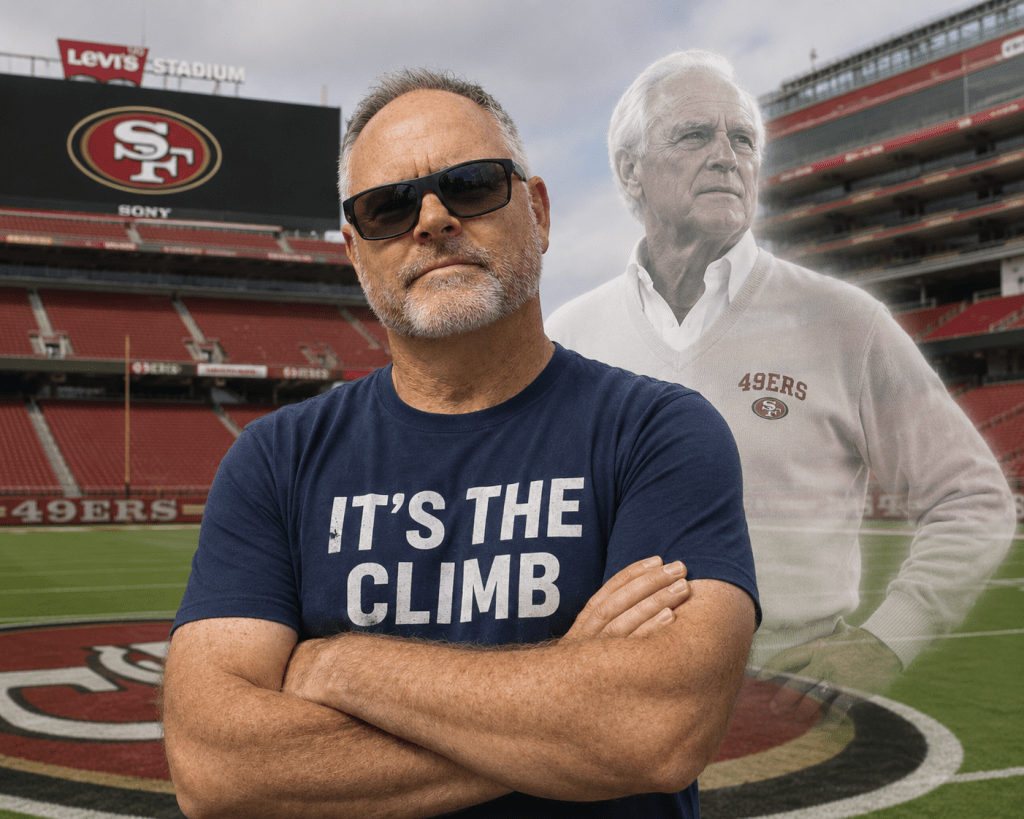
- Watch the story of Walsh and his leadership insights at
Bill Walsh, The Score Takes Care of Itself


You must be logged in to post a comment.