
In Part 1 of this series, I argued that AI misuse in assessment is not only an integrity problem.
It is also a teaching and learning problem.
A motivation problem.
A confidence problem.
A habit problem.
A metacognition problem.
A task-design problem.
A culture problem.
And, perhaps most importantly, it is a problem created by school systems that can sometimes overvalue polished products while undervaluing the human learning journey that produces them.
That first post began with Miley Cyrus, Bill Walsh, and the idea that the scoreboard is not the game. The point was not to dismiss grades, marks, ATARs, ISMGs, rubrics, bands, rungs, or achievement standards. They matter. Of course they matter. But they are not the work.
The work is ‘the climb’.
The work is the learning process: the retrieval, the drafting, the missteps, the source judgement, the uncertainty, the feedback, the revision, the slow development of voice and understanding.
In Part 2, I explored the first of my eight possible responses to AI-disrupted assessment: teaching students the difference between productive struggle and wasted struggle. Students need to know that some struggle is desirable. It builds them. It changes them. It is part of what learning is.
But students also need to know when they are merely stuck — when they need a hint, a strategy, a worked example, a clarifying question, a teacher conference, a peer conversation, or perhaps some carefully bounded AI support.
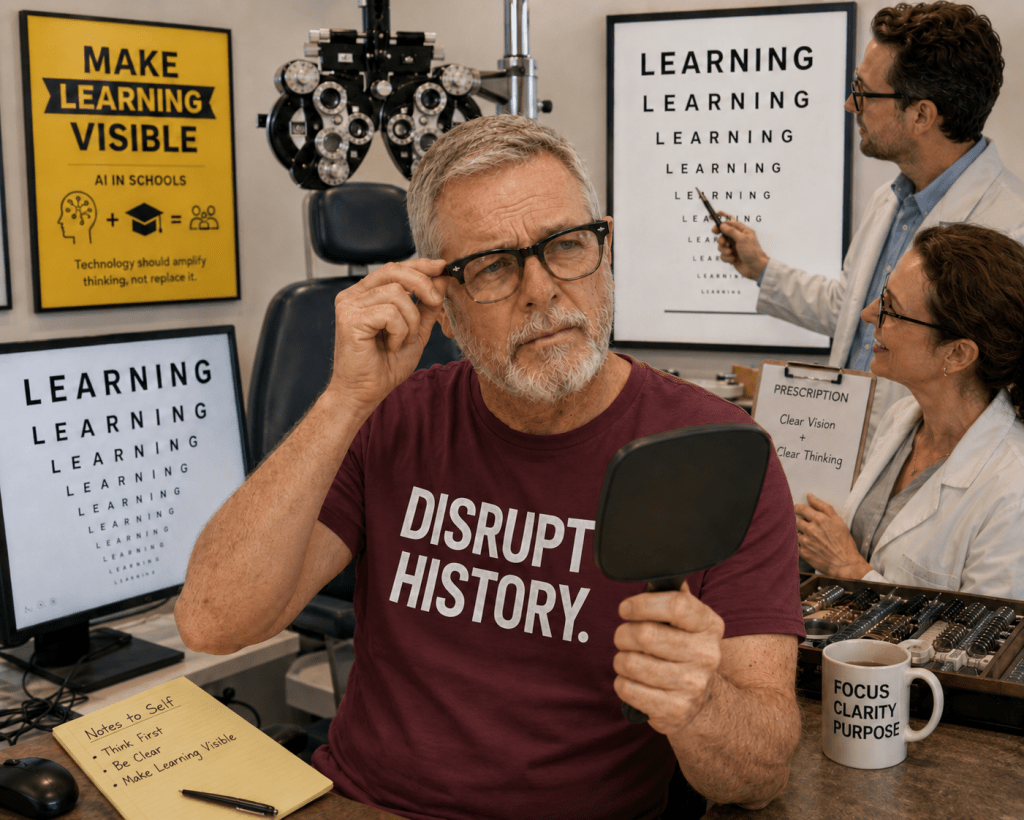
So, Part 2 was about naming the struggle. This Part 3 is about making the struggle visible.
Or, to put it another way:
If ‘the climb’ matters, assessment needs to show ‘the climb’.
Redesign tasks so the thinking is visible
If the final product is all that counts, students will learn to outsource the product. That is not cynicism. It is design logic.
When school rewards only the polished artefact, students learn to optimise for that polished artefact. AI simply makes that optimisation faster, easier, and harder to detect.
This is why Bill Walsh’s Standard of Performance remains so useful to my thinking. Walsh did not build excellence by staring at the scoreboard. He built it by making the habits of excellence visible, repeatable, expected, and taught.
That is a powerful lesson for schools.
If we want students to value the learning process, then we need to design assessment in ways that value the learning process.
If we want students to think first, then we need to create tasks that require evidence of that thinking.
If we want students to use AI as support rather than substitute, then we need to make the human learning journey visible enough that substitution becomes harder, less attractive, and less rewarded.
If we value ‘the human’ then we need to create tasks that centre what we most value in humanity… and amplify those elements.
In other words, we need to stop pretending the final product tells the whole story.
The polished artefact is no longer enough
A polished paragraph is not necessarily evidence of a student’s learning.
A polished essay is not necessarily evidence of a student’s understanding.
A polished essay is not necessarily evidence of a student’s thinking.
It may be. But in an AI age, we can no longer assume that it is. (It was almost certainly flawed thinking before AI came along also, by the way!)
That is the uncomfortable reality.
The TEQSA assessment reform work makes this point clearly. In a world where generative AI can produce passable assessment products, assessment needs to provide richer evidence of student learning. It needs to reveal thinking, judgement, decision-making, reflection, and the learning process itself.
This does not mean every assessment task must become a bureaucratic monster.
It does not mean every draft, prompt, annotation, and conversation needs to be collected, tagged, audited, and stored in triplicate.
Teachers are already busy enough.
But it does mean that we need to rethink what counts as evidence.
The final product may still matter to some extent. But it can no longer stand alone. We need to put a proper focus on the process.
From labels to learning
This connects to something I explored in an earlier post, “From Levels to Learning: Rethinking AI Assessment in History Departments.”
In that post, I argued that the AI Assessment Scale and similar tools can be helpful, but only if they are used as design tools, not as stickers placed on unchanged tasks.
A task cannot simply be labelled “No AI” or “AI permitted” and be considered solved. That is not assessment design. That is labelling. And labels, by themselves, do not teach students how to think.
In that post, I argued that the more important work is to design for process, not only product: to create opportunities for chains of evidence of learning, to include non-AI moments, multiple checkpoints, reflective commentary, teacher conferencing, and visible student decision-making.
That thinking now sits directly inside this series.
If Parts 1 and 2 asked us to value the climb, then Part 3 asks:
Where is the climb visible in the assessment design?
Chains of Evidence of Learning
I have been thinking about this as Chains of Evidence of Learning (CELs). I do not mean this as a new bureaucratic acronym to torment teachers. I mean it as a practical way of asking whether the assessment task gives us enough evidence of the human learning journey.
A chain of evidence might collect evidence of learning across three broad phases of the learning journey our students undertake.
Before AI: evidence of thinking first
This is where students show that they have engaged their own minds before reaching for the help of a convenient AI tool!
Possible evidence might include:
- retrieval attempts (in digital form* via stylus/other tool and/or on paper)
- handwritten notes (in digital form* via stylus* or on paper)
- concept maps (in digital form* via stylus*/other tool* or on paper)
- planning documents (in digital form* or on paper)
- videoed reflections* (such as Microsoft Flip* – formerly Flipgrid*)
- initial paragraph drafts (in digital form* via stylus*/other tool* and/or on paper)
- source annotations (in digital form* via stylus*/other tool* and/or on paper)
- hypothesis drafting (in digital form* via stylus*/other tool* and/or on paper)
- question lists (in digital form* via stylus*/other tool* and/or on paper)
- working notes (in digital form* via stylus*/other tool* and/or on paper)
- first responses to a stimulus (in digital form* via stylus*/other tool* and/or on paper)
- conferencing with peers and/or teachers (individually or in groups, in person, on recorded*, video* via Teams Meeting* or Zoom*)
- “What do I already know?” reflections (individually or in groups, in person, on recorded*, video* via Teams Meeting* or Zoom* with peers or teachers/others; in digital form* and/or on paper)
* Note how many times I reference the appropriateness of using digital tools. I am emphasising them because you should NOT mistake my work here for an argument against devices in the classroom. That could not be further from my intent. I could rant at length about the flawed logic of the anti-device arguments in schools. The accessibility benefits and more of using 1:1 devices such as Microsoft Surface Pros for these activities are a compelling argument for using them! But I digress.
This is where Think First becomes more than a slogan.
It becomes visible. Let’s make thinking visible! (Check out: Visible Thinking | Project Zero and PZ Thinking Routines | Project Zero)
In the language of my Bubble and Burner model, this is where the teacher protects the early cognitive friction of learning. The model argues that students should move from smaller, more bounded AI use towards more complex use as their expertise develops. Its central principle is clear: students need to Think First before drawing on AI support.
That matters.
A student cannot meaningfully use AI to refine an argument if they lack the content understandings to form one. They cannot use AI to challenge their interpretation if they have not yet made an interpretation. They cannot use AI to improve their voice if they have not yet risked putting their own words on the page.
There must be something human for AI to work with.
With AI: evidence of hybrid thinking
This is where students show how they used AI, if AI use is permitted or expected. Possible evidence might include:
- prompt record, screenshots or chat records
- ‘before and after’ comparison notes
- conferencing notes as AI use is discussed and critiqued
- checkpoints (in digital form* and/or on paper and/or face-to-face with the teacher)
- drafts in Word document with Track Changes turned on.
- ‘human’ annotations of AI feedback
- “what I accepted, rejected, and why” reflections
- records of changed questions / analysis notes etc
- evidence of fact-checking or source verification using other sources (such as Google Scholar – check out Google Scholar Labs by the way)
- notes showing where AI output was challenged, corrected, accepted or ignored
This is not about catching students out. It is about teaching them that AI use involves judgement. It’s about building transparent cultures of thinking and learning within the classroom. A culture of high performance with learning at its heart.
Students need to learn that it is important that they remain ‘the human in the loop’.
Students need to learn that accepting an AI response is their decision. Rejecting an AI response is their decision. Changing a prompt is their decision. Using one phrase but not another is their decision. Following one line of feedback and ignoring another is their decision.
Those decisions are where learning may be found.
The QCAA’s assessment guidance reminds us that good assessment still rests on principles such as alignment, equity, evidence, ongoing learning, transparency, validity, accessibility, and reliability. It also points to the need to design assessment that guides students in demonstrating their learning in valid ways while promoting academic integrity. (See also the QCAA’s Developing artificial intelligence capabilities: Guidance for schools)
That is what evidence of hybrid thinking can help us do.
It gives the teacher more than ‘a final product’.
It gives the teacher a window into the learning process.
After AI: evidence of human judgement
After AI has been used, students need to show what remains theirs. This may be the most important phase.
This is where the assessment process asks a crucial question:
What can the student now do that they could not do before?
Not:
Did the student produce something polished?
But:
Has the student changed?
Because learning is not merely the production of an artefact.
Learning is the change in the learner.
Possible evidence at this stage might include:
- evidence of corrections / final decisions in ways of thinking via completion of “I used to think… now I think activities (individually or in groups, in person, on recorded*, video* via Teams Meeting* or Zoom* with peers or teachers/others; in digital form* and/or on paper)
- written or oral reflections (in digital form* and/or on paper/in person)
- oral explanations / post-learning conferences with peers and teachers (in digital form* and/or in person)
- class ‘learner as expert sessions’ where the student discusses their work (with limited access to notes) and engages in a question-and-answer session with their peers and teachers (in digital form* and/or in person)
- completion of transfer tasks
- Acknowledgement of Assistance statements (which should include ALL forms of assistance recieved not just that of AI)
- exploration of what the student can now do independently
- mini-vivas / short in-class demonstrations of skills
- teacher-student conferences (in digital form* and/or in person)
- source analysis with/without access to other support, including peers, tutors, online support, or AI
* Again, please note how many times I reference the appropriateness of using digital tools. I am emphasising them because you should NOT mistake my work here for an argument against devices in the classroom.
The Bubble and Burner connection
This is where the Bubble and Burner model conceptualisation of the teaching and learning process becomes especially useful. In that model, the teacher is not simply a facilitator of access to AI. Nor is the teacher merely a police officer guarding against misuse.
The teacher is the regulator of the learning process. The teacher ‘checks the temperature’ of learning. The teacher adjusts ‘the flame’ that stimulates learning. The teacher decides when to withhold, when to scaffold, when to permit, when to fade, when to challenge, and when to turn the heat down.
That work matters in assessment design.
If we ask students to complete a major task entirely out of sight, with no visible thinking, no checkpoints, no teacher-student conversation, no process evidence, no draft history, no reflection, and no secured demonstration of learning, then we should not be surprised when the final product becomes difficult to trust.
We have designed opacity. Then we complain that we cannot see.
The Bubble and Burner model asks us to design differently.
It asks us to sequence learning so that students first build knowledge, confidence, and judgement before using AI in more complex ways. It asks teachers to regulate cognitive friction so that AI enriches learning rather than replacing it.
That principle applies directly to assessment.
Assessment design should not ask:
“How do I stop AI?”
It should ask:
“Where does the student need to think first?”
“Where might AI appropriately support learning?”
“Where do I need evidence of independent capability?”
“Where will I check the temperature?”
“Where is the human judgement visible?”
Those questions take us beyond panic.
They take us into pedagogy.
Rethinking, not merely securing
Jason Lodge and colleagues have argued that responses to generative AI in assessment need to move beyond simply ignoring, banning, invigilating, embracing, or designing around the technology. The most important long-term work is to rethink assessment itself.
That seems right to me.
Some secure assessment will still matter.
There are times when students need to demonstrate what they can do without AI. In-class writing matters. Oral explanation matters. Demonstrations of skill matters. Retrieval matters.
Closed conditions still have a place.
But if our only response to AI is to drag everything back into locked rooms and timed tests, then, if we’re not careful, we may secure some evidence while impoverishing the learning experience.
The later TEQSA guidance makes a similar point: institutions should not primarily invest in detection regimes and mechanisms but should redesign assessment to capture authentic demonstrations of student capability and comprehension.
That principle travels well into schools.
The answer is not to make every task AI-proof.
The answer is to make learning more visible.


You must be logged in to post a comment.