
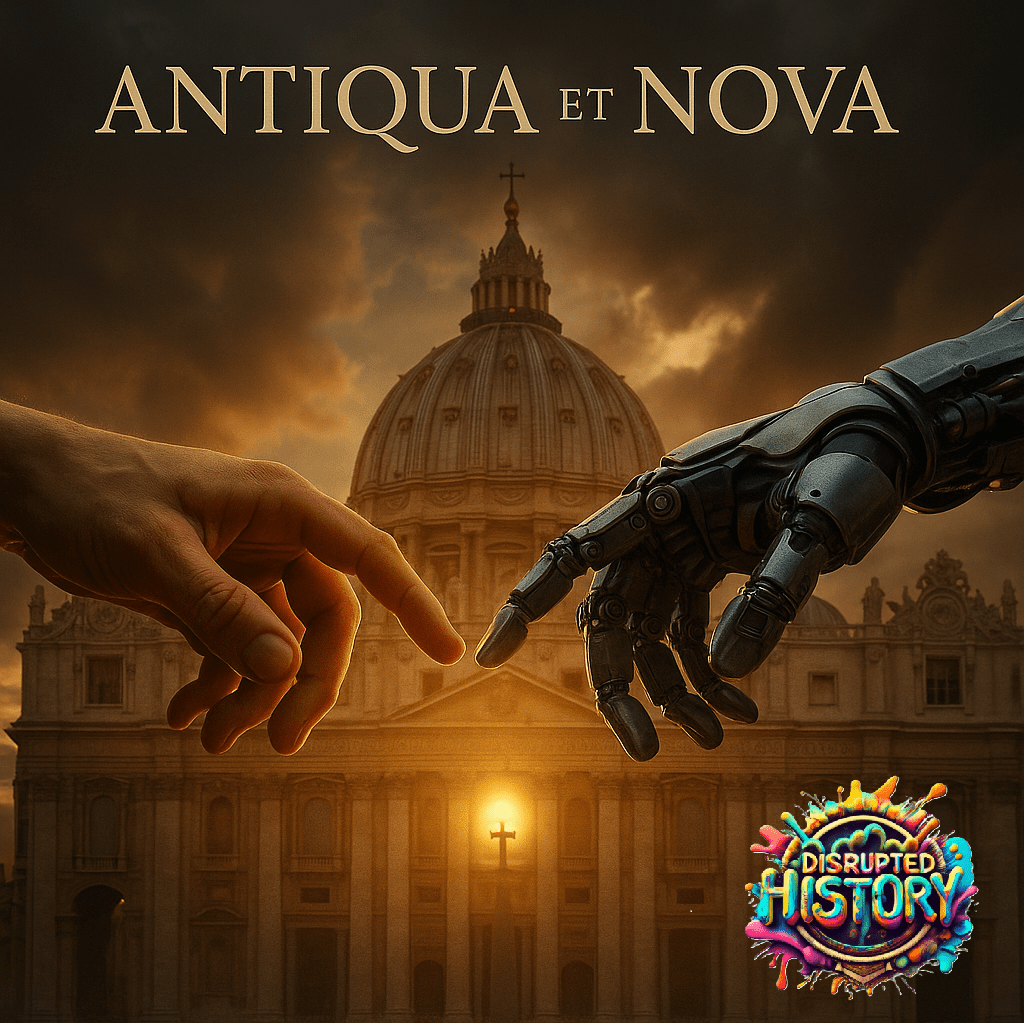
I recently spent time with the Vatican’s Antiqua et Nova: Note on the Relationship Between Artificial Intelligence and Human Intelligence, a document co-authored by the Dicastery for the Doctrine of the Faith and the Dicastery for Culture and Education. At over a hundred paragraphs, it’s as theologically weighty as it is ethically urgent – wide-ranging, bold, and, in parts, surprisingly hopeful. It offers not a narrow policy statement but a sweeping meditation on what it means to be human in the age of artificial intelligence.
As a (quite progressive and secular) Catholic educator and researcher exploring AI-infused pedagogies for history, this document is more than intellectually stimulating – it feels like a bit of moral compass. It reminds me that any work I do in this space, particularly within Catholic schools, must not only reflect innovation but be deeply rooted in ethical discernment, relationality, and an unwavering commitment to human dignity. This isn’t just about what AI can do. It’s about what kind of world we are shaping as it grows.
Wisdom, Not Worry: The Church Isn’t Anti-AI
One of the myths I’ve encountered is that the Church is somehow suspicious of (or hostile to) AI or that Catholic tradition has little to say to contemporary technological debates. Antiqua et Nova dismantles that view immediately. The Church, it affirms, welcomes science and technology as part of the “collaboration of man and woman with God in perfecting the visible creation”.
It accepts the consensus that AI represents an “epochal change.”
“To contribute positively to the discernment regarding AI, and in response to Pope Francis’ call for a renewed “wisdom of heart,” the Church offers its experience through the anthropological and ethical reflections contained in this Note. Committed to its active role in the global dialogue on these issues, the Church invites those entrusted with transmitting the faith – including parents, teachers, pastors, and bishops – to dedicate themselves to this critical subject with care and attention. While this document is intended especially for them, it is also meant to be accessible to a broader audience, particularly those who share the conviction that scientific and technological advances should be directed toward serving the human person and the common good.”
This isn’t the language of spiritual Luddism – it’s a theology of participation that sees technology as a method of creation. A participation that should be engaged with from a stance of ethics, wisdom, and care.
What Antiqua et Nova does critique is functionalism: the flattening of human beings into mere utility, cognition, or productivity.
Antiqua et Nova argues that if AI is used to define or diminish humanity – to reduce education to skill-drills or students to data points – we’ve missed the mark. I’d have to agree. The goal isn’t to imitate humans with machines, but to shape technologies that reflect and respect the full depth of human experience: material, spiritual, moral, and relational.
Human Teachers Are Not Optional
One section landed particularly forcefully: the affirmation of the teacher-student relationship.
“At the center of this work of forming the whole human person is the indispensable relationship between teacher and student. Teachers do more than convey knowledge; they model essential human qualities and inspire the joy of discovery.”
In an age where talk of chatbot tutors and automated grading systems are increasingly normalised, the Vatican insists that “teachers do more than convey knowledge; they model essential human qualities and inspire the joy of discovery.” Antiqua et Nova reminds us that teachers’ presence, their care, their modelling of wisdom and attention to individual dignity is indispensible – and none of that is replicable in code.
“We must break that idea of education which holds that educating means filling one’s head with ideas. That is the way we educate automatons, cerebral minds, not people. Educating is taking a risk in the tension between the mind, the heart, and the hands.”
For me, this isn’t a nostalgic nod to tradition. It’s a reminder that in the age of AI, pedagogy must be more human, not less.
The document quotes Pope Francis: “Educating is taking a risk in the tension between the mind, the heart, and the hands.”
Purpose-Driven Pedagogy
One line that keeps echoing in my thinking from the document is:
“True education strives to form individuals with a view toward their final end and the good of the society to which they belong.”
That’s a statement soaked in purpose.
In Catholic schooling, we often talk about holistic formation – but AI is forcing a sharper focus.
What are we forming students for?
If the answer stops at employability, university entrance scores, future income potential, or compliance, we’ve surrendered to the very utilitarianism the Church warns against.
Antiqua et Nova argues that we must shape AI pedagogies that cultivate ethical discernment, critical thinking, and digital civic agency. This aligns closely with my own research goals: to co-design history pedagogies that engage students as thinkers and change-makers – not just users of tools but stewards of stories, justice, and truth.
Human Intelligence Is Relational, Embodied, and Spiritual
Antiqua et Nova also returns to philosophical anthropology, drawing on St Thomas Aquinas’ distinction between intellectus and ratio. AI may excel at computation, but human intelligence is more than this.
Human intelligence (HI) includes intuitive insight, moral conscience, creativity, and love. It is inherently relational – exercised “in dialogue, collaboration, and solidarity.”
That’s where the Church draws its clearest boundary: AI can assist, but it cannot (must not) replace our relational, ethical, and spiritual capacities.
In the context of education, this means that schools must attend to more than data literacy or platform management. We are being called – urgently – to shape learning cultures grounded in dialogue, discernment, and deep connection.
We are, in other words, called to teach for the whole human.
Researchers Are Called, Too
Near the end of the document, there’s a call that resonates personally: a call for those in the university sector to lead in “wisdom and creativity,” helping society navigate these changes toward “ethically sound applications that clearly serve the cohesion of our societies and the common good.”
That is the terrain I want my work to stand on.
As I continue developing a flipped, agency-oriented, AI-infused history pedagogy, Antiqua et Nova reminds me that this work is about more than frameworks or lesson plans. It is about forming people who can live wisely in a digital age – who seek truth, build community, and shape a future animated by care, justice, and faith.
Toward a Wisdom of the Heart
The final lines of Antiqua et Nova offer more than a gentle encouragement – they issue a profound challenge: to cultivate a “wisdom of the heart” capable of guiding AI’s positive integration into human life.
This is not mere sentimentality. It’s a call to educators to lead with conscience, community, and care – to resist the drift toward automation for its own sake, and to shape AI in ways that foster solidarity, seek truth, and promote the common good.
For those of us teaching history, this “wisdom of the heart” can be both anchor and compass. In a time when generative AI can summon facts, fabricate narratives, or flood us with simulations of the past, we are called not just to deliver content but to form character. To teach students not just how to use AI, but how to discern with it – how to interrogate the sources it draws upon, challenge the power structures it might reinforce, and reimagine historical learning as a humanising act.
“Wisdom of the heart” in history classrooms means embracing the digital without surrendering to it. It means holding space for ambiguity, community, and dialogue. It means using AI not to replace historical thinking, but to amplify students’ ability to engage ethically, creatively, and courageously with the past – so that they might shape a more just and truthful future.
 Disrupted History
You must be logged in to post a comment.