
Once upon a time, Clippy bounced onto our screens with an enthusiastic “It looks like you’re writing a letter!” and a well-meaning (but often unhelpful) set of suggestions. Clippy, Microsoft’s infamous Office Assistant, was an early attempt at making AI useful in our workflows. While it never quite got there, Clippy walked so today’s AI tools – like ChatGPT and Copilot – could run. But running without direction can lead to chaos, and that’s where Plussy and Vibeprompting come in.

Meet Plussy: The Key to Smarter AI Use
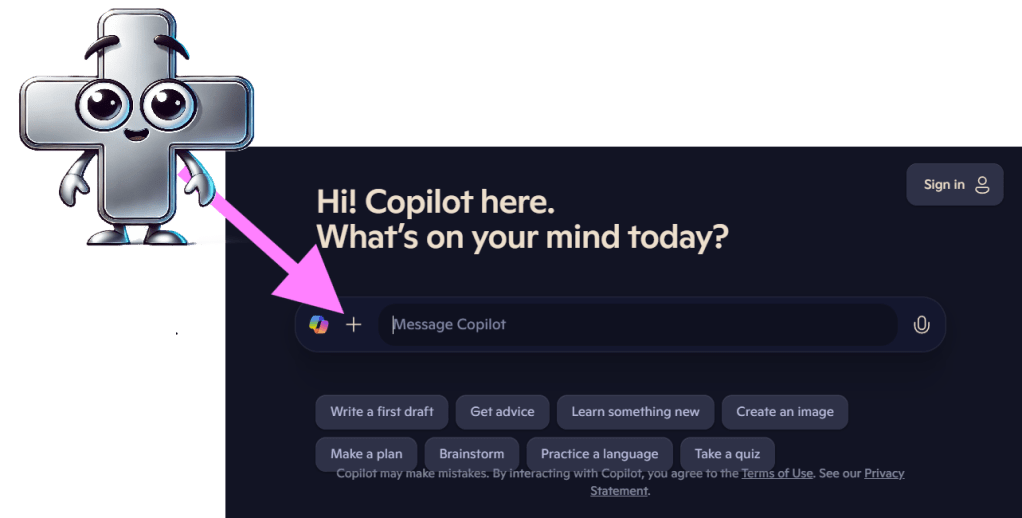
Plussy isn’t an AI itself; it’s an icon and a mindset. It’s a simple but powerful reminder to guide AI effectively by using Retrieval-Augmented Generation (RAG) documents – curated files that provide context and ensure responses are relevant. Unlike Clippy’s generic, often misplaced suggestions, Plussy represents an AI-friendly best practice: the quality of the output depends on the quality of the input.
But here’s the catch: Not all documents should be added as RAG attachments. In our rush to get better AI answers, we must also think about data privacy and security. Every time you upload a document to ChatGPT or Copilot, consider:
- Is it ethical to share this information? Personal, proprietary, or confidential data should never be shared.
- Am I following best practices for data privacy? Anonymising sensitive details, reviewing terms of service, and ensuring compliance with school or company policies are critical steps.
- Does this document align with my AI use case? If the goal is to enhance AI-generated responses, the document should be relevant and structured to support that.
Plussy in Action: A Guide for Teachers and Students
Plussy serves as a reminder that AI works best when given structured, meaningful input. For teachers and students, this means leveraging RAG documents to personalise and enhance learning experiences. Here’s a few suggestions how:
For Students:
- Guided Assessment: Upload a marking rubric to AI tools to help generate feedback aligned with assessment criteria.
- Scaffolded Learning: Add an assignment task sheet to structure AI-generated study plans.
- AI-Powered Tutoring: Use class readings and notes to create an AI tutor tailored to specific coursework.
- Differentiated Learning: Provide AI with personal learning goals and content to receive individualised assistance.
For Teachers:
- Resource Creation: Upload curriculum documents to assist AI in generating lesson materials.
- Assessment Development: Use AI to draft comparable alternative assessment tasks based on existing ones.
- Differentiation Strategies: Create varied learning activities by providing AI based upon existing learning activities.
- Enhanced Historical Inquiry: Use AI to support source analysis by guiding it with structured prompts and context.
“Plussy Lives Here!”
Now you have the principles in place, you can direct your students and colleagues to Plussy in OpenAI’s ChatGPT.

Plussy also lives in Google Gemini!

Plussy’s also got a home in Microsoft Copilot!
True Retrieval-Augmented Generation (RAG) and Plussy’s Role
True RAG goes beyond simply attaching documents – it ensures AI can retrieve, interpret, and apply external knowledge effectively. Plussy embodies this principle by encouraging thoughtful, structured input to optimise AI responses. Without proper RAG, AI works in isolation; with RAG, it becomes a contextual powerhouse. Plussy isn’t just a cute icon – it’s a simple methodology for smarter AI use.
Vibeprompting: Shaping AI’s Tone and Perspective
Plussy works hand-in-hand with Vibeprompting, a concept described by Ethan Mollick in his March 12, 2025, One Useful Thing Substack post, Speaking Things into Existence. Mollick highlights AI researcher Andrej Karpathy’s assertion that “the hottest new programming language is English” and explains how vibe prompting (which he at the time referred to as “vibecoding”) is the process of directing AI by providing iterative feedback. As Mollick writes:
Expertise clearly still matters in a world of creating things with words.
After all, you have to know what you want to create; be able to judge whether the results are good or bad; and give appropriate feedback…
When used together with a carefully worded prompt, Plussy ensures AI has the a suitable knowledge base (RAG), while vibeprompting ensures AI communicates that knowledge in the right way.
Testing Plussy + Vibeprompting: AI-Enhanced Source Analysis
Recently, I experimented with the Plussy approach to analyse a historical source as if I were a Year 12 student. The source was a Chinese propaganda poster from the Korean War (1950). By integrating structured RAG documents with strategic prompting in ChatGPT 4.5, I achieved some very impressive results.
In this experiment, I applied:
- The 2x I Statements and a Verb Approach (previously covered in this blog) for structured historical interpretation.
- The Plus 3 Routine to remind AI of multi-turn chat importance for iterative, high-quality analysis.
- Vibeprompting to shape AI’s tone and perspective for richer engagement and historical nuance.
The AI-generated analysis seemed more coherent, insightful, and historically grounded. The responses generated very much reflected what I had hoped for in my role as a student. Plussy structured the AI’s knowledge, and Vibeprompting ensured it communicated with clarity, engagement, and depth.
You can view a screen recording of the experiment by click HERE.
School Teachers: The Original Vibeprompters
One of the key insights from Mollick’s post is that human expertise is still essential in guiding AI effectively. Teachers – particularly those in high-language disciplines like English, Literature, and History – are already highly skilled at the core practice of Vibeprompting.
Teachers…
- Provide clear instructions with purpose and context.
- Guide through iterative checking and correction.
- Adapt and refine based on student responses – just as we should with AI interactions.
… often under VERY demanding circumstances!
I have long argued that “prompt engineering” isn’t really a thing – at least not in the way it’s often marketed.
Teachers are already expert prompters. We are the already trained vibeprompters! It’s part of our DNA as a profession!
We instinctively, perhaps intuitively, provide structured, purposeful directions and follow up in responsive iterative ways to create meaningful outcomes. That’s exactly what AI needs to function at its best.
An Important Reminder About Ethical AI Use and Safety
While RAG and Vibeprompting enhance AI performance, ethical and responsible data handling is paramount. Teachers and students must remain vigilant about:
- Protecting student safety, their identities and any confidential records.
- Maintaining student voice, focusing on learning and the holistic development of the learner, and building cultures of integrity and transparency
- Using AI-generated outputs critically and verifying accuracy.
- Ensuring compliance with educational data policies and ethical AI guidelines.
This should be at the heart of all use cases for AI in schools.
Final Thoughts
Plussy exists to remind us that AI is a tool, not a mind-reader. Without proper guidance, it will guess – and guesses can be inaccurate or even risky. With the right documents, used responsibly, AI can provide insights, summaries, and contextualised responses that enhance productivity and learning.
And when combined with Vibeprompting, AI doesn’t just retrieve knowledge – it communicates it in a way that resonates and makes sense.
So next time you’re about to engage with AI, take a moment. Channel your inner Plussy. Upload wisely, prompt with clarity, and always prioritise ethics, safety, and privacy.

* This post was updated in January 2026 to bring some terms in the post into line with more contemporary usage.
 Disrupted History
You must be logged in to post a comment.