
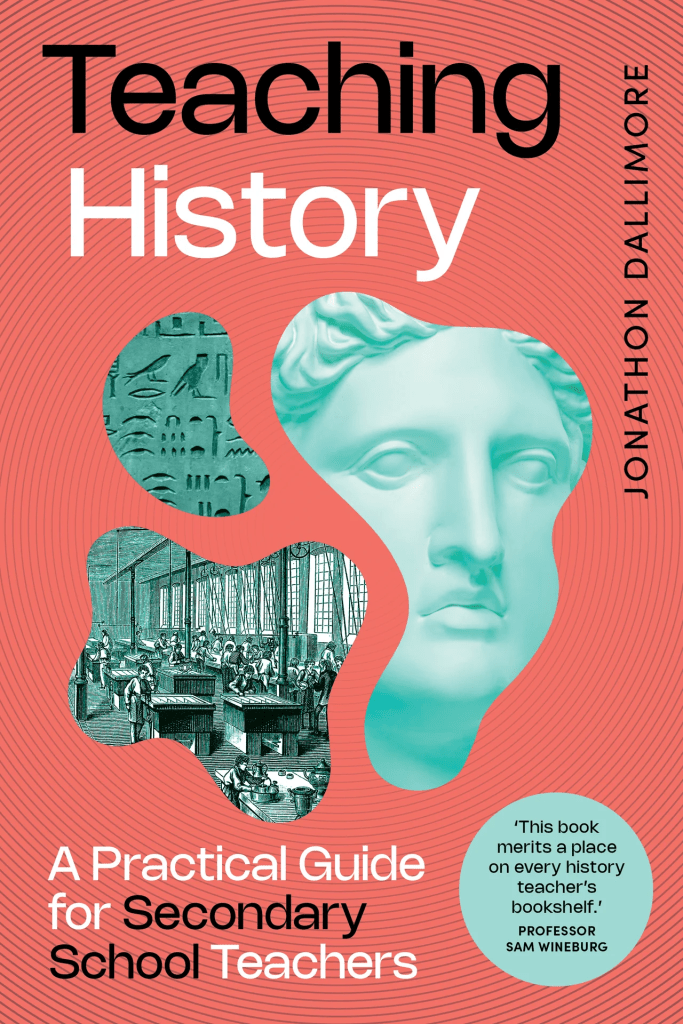
Jonathon Dallimore’s Teaching History: A Practical Guide for Secondary School Teachers is a book that many history educators, including myself, are currently engaging with. If you have been on that journey, I’m sure that you can see the value in this text. I’d highly recommend this book. For teacher-educators, it would make an excellent set textbook in a pre-service teaching course. For pre-service teachers and early career teachers, I’d suggest it may be an excellent desktop handbook to guide your practice. For experienced teachers, I’m confident that it is a powerful aid for ongoing professional reflection.
As the executive officer of the History Teachers’ Association of New South Wales (HTANSW), Dallimore brings deep expertise in both classroom practice and the pedagogical frameworks that underpin history teaching. His work is grounded in research and best practice, and it was pleasing to see names such as Wineburg, Shulman, Sherrington, Marzano, Parkes, Martell, Stevens, Barton, Levstik, van Drie, and van Boxtel featured in the “Further Reading” lists that are offered at the end of each chapter.
Passion, Purpose, and Persistence
One of the book’s greatest strengths is its structure by which Dallimore groups concise and accessible chapters into three parts (Part One: Setting Foundations, Part Two: Planning – Year Levels and Topics, and Part Three: Sequences and Lessons). As I read, I found myself mentally grouping its themes around three pillars that I try to bring to my teaching practice: passion, purpose, and persistence.
Part 1: The Foundations
This section resonates deeply with those who believe history education is more than content delivery. Dallimore offers some powerful reflections in this space to guide teachers. To me, it’s about instilling a sense of identity, connection, and engagement with the past, present, and future. His take in this space is certainly one that many teachers will connect with. Chapter 1’s call to take joy in history is a rare and refreshing stance for a text on pedagogy to take. Too often, education discourse becomes dominated by discussions of policy, curriculum, and assessment, neglecting the fundamental reason why we teach in the first place. Dallimore urges teachers to prioritise their passion for the subject.
“[I]n an age where teaching has become more bureaucratic, technocratic, and procedural than ever, I think it is fundamentally important to remember what it is about this subject that we love and what might have most appeal for our students”.
Similarly, Chapter 2 discusses the agency of history teachers, reminding us that teaching history involves a professional responsibility to engage with complex narratives, including the often-overlooked histories of First Nations peoples. This aligns with the growing emphasis on teaching for decolonising the teaching of history. It also aligns closely with my own view that history pedagogy must embrace reparative and future-oriented historical thinking. As history educators, we must grapple with how history is taught in ways that empower students to think critically about yesterday and today while preparing them to shape tomorrow.
Chapter 3 continues this thread, advocating for teachers to develop their own philosophy of teaching history.
“Developing a personal sense of why you believe that studying history is important will help clarify your purpose as a teacher and sustain you when the work inevitably gets tough.”
This rings true. A strong personal vision sustains educators not only through the daily challenges of teaching but throughout the course of a long career. As someone who has been in this profession for decades, I can attest that times will get tough. Sometimes tougher than you could ever imagine. As people, teachers must find a value and meaning in teaching that represents more than grades or exam results. Dallimore challenges teachers to develop a deep sense of purpose that sustains us – helps us to persist – in the face of life’s inevitable challenges.
Engagement Versus Entertainment
Dallimore’s discussion of student engagement, particularly in Chapter 8, certainly caught my eye. The chapter, titled “Aim to Engage, Not Entertain,” explores the danger of mistaking entertainment for meaningful learning. He warns against “accidentally slipping into modes of entertainment in the hope that somehow students will learn something along the way,” cautioning that history teaching should not prioritise short-term excitement over deep intellectual engagement.
This echoes longstanding observations in history pedagogy about the role of engagement in learning. If the focus of activities in history classes is on ‘entertainment’ rather than learning, no true historical thinking can happen! Historical thinking requires discomfort – it requires students to grapple with complexity, challenge assumptions, and make sense of conflicting perspectives. Engagement is important, but it should be the by-product of a well-structured and meaningful learning experience, not an end in itself. (This conversation, for me, also connects to moves in education to scaffold away complexity in the name of direct instruction and reducing cognitive load. Like engagement, those approaches and insights are valuable BUT may lead history educators to ‘accidentally slip into modes’ of teaching which reduce opportunities for students to engage in truly empowering historical thinking.)
As someone who has written about moving beyond engagement in history education, I approached this chapter warily. However, Dallimore successfully differentiates between engagement and entertainment, reinforcing that engagement must be tied to purpose.
To me, if we focus on history’s role in fostering identity, connection, and civic agency, genuine engagement follows.
Parts 2 & 3: ‘Getting stuff done’
While Part 1 lays the philosophical foundations, Parts 2 and 3 provide invaluable practical guidance for history teachers at all career stages. My daughter, an early career teacher, refers to the practicalities of teaching as “GSD” – “getting stuff (?) done”. Pre-service, early career teachers, and many others require thoughtful, wise, and tested mentorship on how to ‘GSD’. The latter parts of this book are ideal for that purpose. Topics such as historical inquiry, unit planning, and assessment design are explored with clarity and depth.
Chapter 15 on assessment is particularly strong, offering insights into questioning, scaffolding, and student choice – key elements in designing assessments that not only evaluate knowledge but also promote historical thinking. This aligns with best practice pedagogies which, since the 1990s, have advocated for assessment tasks that require students to ‘do history’ and to ‘think like historians’. Setting assessment deep within the book, to me, sends a strong signal: the high-quality teaching of history is about many things BEFORE we discuss assessment tasks! Sadly, so many conversations about teaching begin and end with assessment.
Chapter 21, which addresses technology in history teaching, also stood out for me. Dallimore takes a measured approach, encouraging teachers to use digital tools purposefully rather than for their own sake. This mirrors Pratschke’s discussions around education, artificial intelligence and pedagogy. She, like Dallimore, would argue that technology should be leveraged to enhance learning rather than dictate pedagogical choices. While I am perhaps more optimistic than Dallimore about technology’s role in history classrooms, I would agree that edtech corporations and others promoting the use of digital technology in classrooms may not be truly learner or learning centred. Technology must be used with intentionality. Technology, including AI and platforms such as Education Perfect, are not a panacea for every perceived shortcoming of schools and education. Highly impactful teaching practice may be enhanced by purposeful use of technology. Technology is not a pedagogy – it’s a tool for learning. Teachers must learn to use their ‘tools of the trade’ effectively.
Finally, Chapter 25 is an excellent resource for early-career teachers, offering structured lesson templates and descriptions of different modes of instruction that are grounded in the reality of practice. While it’s getting very limited treatment in this review, I suspect that for many early career teachers, this could well be one of the most annotated, dog-eared, and flipped through parts of the book. This chapter alone makes the book worth purchasing for new teachers or those mentoring pre-service teachers.
Final Thoughts
Dallimore’s book is an essential part of the library for history educators. It blends philosophy, research, and practical strategies into a cohesive and accessible guide. What makes this book stand out is its emphasis on ongoing professional growth – each chapter concludes with self-reflection prompts and suggested questions that early-career teachers can ask experienced colleagues.
If you’re a pre-service teacher or early-career teacher reading this, I’d encourage you to use those prompts to deepen your thinking—and if you’d like to continue the conversation, reach out to me via social media or my website. I’m more than happy to be one of those experienced teachers Dallimore suggests you seek out. Let’s keep the discussion going!
Purchase a copy
Details: Dallimore, J. (2025) Teaching History: A Practical Guide for Secondary School Teachers, Amba Press, ISBN: 9781923215481.
This book can be ordered through:
 Disrupted History
You must be logged in to post a comment.