This Teacher’s Journal: Blog Post 4 | February 16, 2025
The season of ‘deep green leaves’ has arrived. We’ve moved beyond promoting the ‘green shoots of learning’ (See This Teacher’s Journal: Blog Post 1 | January 24, 2025 – Disrupted History) through in-flipped learning and into a space where students are tackling historical complexity, using AI as a scaffold rather than an authority, and engaging with primary sources not just as information but as contested narratives. Generally speaking, students’ early engagement with historical thinking in my classes is showing some early signs of evolving into something more confident, more layered, more complex.
The patterns emerging across Years 9, 10, and 12 show that:
- Flipped learning, including students’ early experiences of in-flipping, has laid some strong foundations, and my students are ready for deeper historical thinking. Students are showing signs that they are taking ownership of their studies of history. They have moved beyond simply absorbing content, they’re questioning, constructing, and debating interpretations of source material.
- AI use in class is being embedded seamlessly. It’s being used for structuring, inquiring, and scaffolding rather than content delivery. AI is being used as a co-pilot. It’s not blindly trusted. Students are using it to scaffold ideas, assembly chronologies, develop deeper understandings, test arguments, and structure their thinking. Students are using AI to support their learning in ways that move beyond using it as a simple substitute for a search engine. By developing their prompt writing and follow up iterative chat skills, they are challenging, refining, and verifying what it produces.
- Primary sources have shifted from “things we read” to “things we interrogate.” A deepening of the skills of historical thinking has been evidenced though active engagement with the sources being used in class.
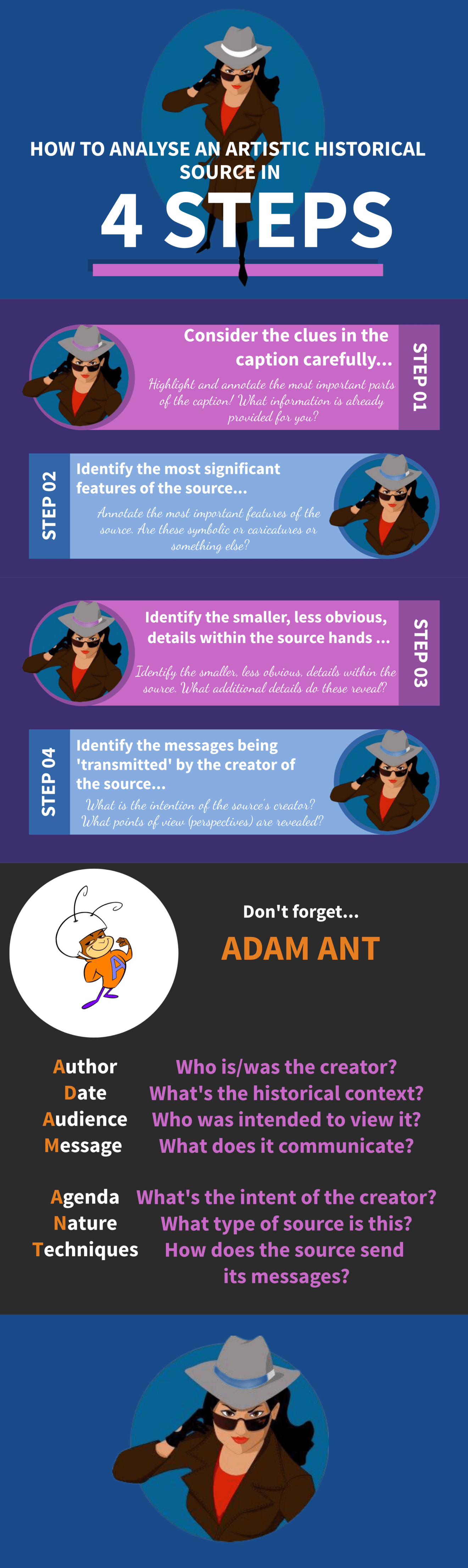
- Structured routines that assist students with source analysis, like use of the mnemonic ADAMANT, are becoming second nature in my classes. Further, instead of being a form of performative checklist thinking, students are making decisions about what aspects of a source matter most, using these frameworks as a launchpad for deep analysis and inquiry, not just a formula for superficial surface level examination of sources.
This week, these themes played out in different ways across my classes. But there’s another observation worthy of note, one that sits at the intersection of pedagogy and educational structures – the tension between deep learning and the pressures of assessment. Students in all my classes are seeking the reassurance that the deeper thinking that they are engaging in will support their achievement of grades. This suggests to me that students (and perhaps many families and even teachers) conflate learning with the achievement of grades. Perhaps there’s a sense of grades creating a culture of ‘fear-based learning’ that must be challenged. In this culture, classroom activities are only valued in that they assist students in their chase “good” grades. In this culture, extrinsic motivation becomes overly significant. Learning must exist in service of a greater purpose.
Despite these cultures within our education system, students in my classes have truly been present to their learning. This has been pleasing. There have been several times when I’ve had opportunity to explicit discuss with students – usually on an individual basis – the wider purposes of their learning. There is ample evidence that students are looking for schools to ‘do more’ than teach to assess.
That said, my Year 12 approached a structural wall within the school system. There has been a necessity of fast-tracking their authentic engagement with learning in preparation for the issue of a summative assessment task – one which contributes 25% of their exit grade. The significance, nature and timing of that task drives the direction and focus of what happens in my classroom from next week. This is a common experience in many classrooms. This forced me to reflect:
To what extent, if at all, does using Year 12 as a means of providing universities with a method of sorting applicants prioritise learning or the greater purposes of education? To what extent have we, as a society, handed over (at least) a year of the education of young people to those who see schools as part of a selection process for higher education?
In contrast, my Year 9s and 10s have enjoyed the luxury of some space for their learning in teacher-led historical inquiry. This space has allowed students to build their skills in historical literacy at a more natural pace and to engage with their peers. For these students, the flipped approach has given them a foundation of content from which they can build. They are now beginning to demonstrate a desire to question, a willingness to collaborate in the construction of meaning, and to engage in structured analytical processes that extend the study of history beyond content recall. As such they are developing skills that will help them to take agency in their lives.
Here’s how those themes played out across each class this week. Note: This blog will focus on two classes in detail. Similar experiences were noted in my other classes but these are addressed in less detail.
Year 12: Flipping for Deep Learning in a High-Stakes System
For my Year 12 students, this was the last week before their summative assessment task is issued. The goal of the last few weeks have been to allow students to establish a solid grounding in content understandings before an abrupt shift in focus to assessment preparation takes place. After weeks of focusing on laying groundwork for deep learning and engagement with sources, structural requirements around assessment will shape historical inquiry, deep engagement with sources, and scaffolded historiographical thinking in ways that could – and often do – become performative. Students are required to package their knowledge and abilities into a structured response for assessment. This has often the tendency to shift the focus from genuine historical thinking into a form superficial word play in which the thoughtful work of pedagogical leaders in historical thinking (such as Seixas) is coopted into the language of assessors and syllabus writers.
Putting my fundamental sadness at this aside (*sigh), it was pleasing to note that this week, the Year 12 students:
- Critically engaged with secondary sources. For example, they had an opportunity to interrogated Delia Davin’s historiographical perspective on Mao’s leadership of China.
- Used AI as a structured research assistant, prompting it to extract key arguments, historiographical perspectives, and critical responses to Davin’s work.
- Used the Search Coach app in Teams and lateral reading strategies to cross-check AI-generated claims.
- Considered how Davin’s western perspectives and focus on women’s history might have shaped her portrayal of Mao’s leadership… and the reliability of that portrayal.
- Had some fun while engaging in a high-energy, gamified review and sense-making session of ‘competitive mind mapping’. (So often Year 12 is NOT about having fun as you learn!)
- During this final session the class was divided into two teams who raced against the clock to construct competing concept maps that traced the most significant elements of content that they had unlocked in their studies to date.
- The rules of competition were simple: One student per team had 5 minutes to write, while teammates coached, debated, and refined the map in real-time. This process continued for six rounds as a relay with the two teams going head-to-head.
- The results? Clear conceptual understanding, rapid recall, and spontaneous peer teaching.
- Engaged with authentic Maoist-era primary sources. Students physically handled a 1967 edition of Mao’s Little Red Book and a Cultural Revolution-era wind-up alarm clock featuring Mao’s image.
- Why does this matter? Because the act of touching and examining an object – rather than just seeing it in a slideshow – makes history tangible, real, makes it more relatable and more human.
The week culminated in the completion of a Teams Assignment – short screen-recording of students’ explanations of their individual mind maps. In this assignment students articulated their understandings aloud before the assessment task is set in a form of ‘readiness testing’. Students will receive individual feedback from me prior to their engagement with the assessment task. A Microsoft Reflect check-in accompanied this Team based Microsoft Flip assignment. This process helps to ensure that students could express any concerns about workload, stress, or confidence in their readiness.
While these students are performing at a high level, the larger structural problem remains – assessment becomes the primary focus of class activity rather than historical inquiry and learning. assessment become the driver of pacing and activities. In many ways, I believe, this is the opposite of what deep historical thinking requires.
Year 9 (Full-Year Course): Political Cartoons, Primary Sources, and Revolutionary Thinking
The transition from content acquisition to historical thinking is now fully underway. This week, my full-year Year 9 History class tackled Michel Henin’s 1789 political etching / cartoon, We May Hope This Game Will Soon End – a satirical critique of France’s Ancien Régime.
We moved beyond the rote “identify and describe” approach that students often default to when looking at visual sources, and instead, focused on how students might analyse more fully to deconstruct meaning, perspective, and intent.
The process followed a structured but open-ended framework similar to a think-pair-share strategy. The process provided both hard and soft scaffolding for students as they engaged in higher order thinking.
Step 1: Think! Independent Analysis in OneNote
Students were given high-resolution digital copies of Henin’s etched cartoon and tasked with annotating them in OneNote. Before the students starting their individual working time, they were reminded of the importance of examining carefully any context, labelling or statements provided with the source before deeply engaging with the source itself. This focus is an important thinking routine when working with sources.
On this occasion, as in syllabus aligned short response to stimulus tasks set for students in examinations, the primary source image was accompanied with a short “Context Statement” from which the students might work. Other than this statement, I provided no background to the sources at all during this stage – forcing them to engage visually and contextually before I layered in any historical scaffolding. Students annotated the context statement with styluses during this phase. They were then directed to annotate with their styluses the major (“key”) features of the primary source image itself. They were able to define and choose for themselves what those ‘major features’ were.
- Students were required to work and annotate the source individually at this stage. The short time on this task was a precursor to collaboration. Without such a stage, any likely collaboration would have been superficial.
- Students were reminded to ‘think before they speak’ about the source, to ‘slow down’ their reactions and sharing to allow a moment’s reflection and to concentrate their attention, and to ensure that what they shared in collaboration was something more constructive than the ‘sharing of ignorance’.
- No AI assistance was used at this stage. It was important for students to apply their ‘human intelligence’, prior learning, and own insights to the task at this stage.
Step 2: Pair and Share! Collaborating in a phase of structured analysis
In this second phase of the activity students worked in small ‘elbow buddy’ groups of two or three. Their goal? Identify major symbols, infer meanings, and raise initial questions. At this stage, students worked on A3 sized paper copies of the Henin source. After whole group discussion of the context statement, which drew attention to the importance of the Author (sometimes an Artist, Creator or Publisher) and the Date (the historical or chronological context) for understanding the source, the students were allowed to collaborate to annotate shared copies of the source. During this phase, I worked with smaller groups of students on questions, issues, interests, and insights they had as they engaged with the source. This was a form of soft scaffolding. Periodically, the whole group was interrupted to ensure opportunities were taken to guide the inquiry and to ‘hard scaffold’ the experience.
A core piece of hard scaffolding for students in this activity was use of the mnemonic ADAMANT as the students ‘unpacked’ and analysed the source. ADAMANT is a structured yet flexible framework that helps students systematically interrogate historical sources. Instead of merely identifying features, students use ADAMANT to prioritise, contextualise, and evaluate elements of sources based on their historical and historiographical significance.
Each element of ADAMANT represents a critical aspect of source analysis, but not all elements carry equal weight for every source. Henin’s cartoon, a map (such as Walter Crane’s as used in another class), letters and ‘histories’ (such as accounts of the Vesuvian eruption by Pliny and Cassius Dio) and government policy document require different focal points – students must decide which elements matter most in each case.
ADAMANT: A Framework for Source Analysis
- A – Author: Who created this source? What were their political, social, or economic motivations? What do we know about their background? Were they part of the ruling elite, an opposition group, an eyewitness, or a later historian? Did they have something to gain or lose by shaping public perception in a certain way?
- D – Date: When was it created? How does its historical context shape its meaning? Was this created during an event (firsthand perspective) or after (revisionist interpretation)? Did the political climate at the time encourage propaganda or suppression of certain views? How might a source from before an event differ from one produced years later in hindsight?
- A – Audience: Who was the intended audience? Who was excluded? Did the source have multiple intended audiences? Who were the primary audience? The secondary? Other audiences? How might their reactions vary? How did the author’s choice of language, style, and imagery reflect their audience? Would the source’s message or techniques have been different if intended for another group?
- M – Message: What is the source explicitly saying? What implicit messages or biases are present? What are the underlying assumptions or biases embedded in the source? Does the message support or conflict with what we know from other sources?
- A – Agenda: What was the creator’s intent or purpose – propaganda, critique, persuasion? Was this meant to inform, persuade, critique, or deceive? Is it an honest record, or does it serve a political goal? What impact did this source have on its audience? How successfully did the creator achieve their intent?
- N – Nature: What kind of source is it – primary or secondary source? A ‘trace of the past’ or a ‘retelling of the past’? A private letter, advertising, graffiti, cartoon, speech, government document, an artefact, a building, propaganda? A literary source, a non-literary source? How does this impact reliability?
- T – Techniques: What artistic, rhetorical, or structural techniques does the source use? How does the layout, symbolism, or structure affect interpretation Does this source use loaded language, exaggerated imagery, or emotional appeals? What is left unsaid or omitted?
By applying ADAMANT, students move from surface-level analysis to deep historical inquiry. It helps them not just identify features but prioritise, question, and interpret – a crucial skill in historical literacy.
The ADAMANT experience was then used as the basis for whole class sharing. Through a Socratic dialogue around the source, the group were group asked a series of ‘significant’ questions about the features, techniques and messages evident in the source. This conversation required critical thinking in order for the class to arrive at a consensus on the meanings and issues raised by Henin’s source. It’s been argued that such a dialogue promotes student interpersonal skills while stimulating conceptual – and historical – understanding.
After some time working in this mode, students were then set an individual AI-supported inquiry challenge. It was pointed out that Henin was very deliberate in the construction of his artwork. Nothing was left to chance. Students were required to unpack the smaller but significant features of the image that were suggestive of First and Second Estate privilege during the Ancien Regime.
Step 3: AI-Supported Inquiry
Instead of giving students an explanation of the symbolic use of ‘fat rabbits’, cabbages, seeds and birds in Henin’s artwork, I required students to first collaborate themselves to unpack their own meanings. Given the students’ early / novice understandings of the era, it was anticipated that few, if any, of the students, would fully unlock the symbolism of this aspect of the image from this starting point. I then introduced students to the concept of class privileges and allowed them to use AI for assistance in solving this challenge. They were required to use the “2x I statements and a verb” and “Plus 3” methods outlined earlier in this blog (see).
Many of their prompts were used in ChatGPT or Copilot and looked something like this:
“I am a year 9 history student. I am studying the French Revolution and the Ancien Regime. I am studying a 1789 cartoon titled Let Us Hope This Game Soon Ends. It has fat rabbits, cabbages, seeds and birds in the background of this image. I wonder if they represent wealth or privilege. Generate three possible historical meanings for these symbols.”
[Note: This example uses 4x I statements and a verb.]
It was noticed that no student thought to upload a copy of the source as a form of RAG (retrieval-augemented generation) attachment.
The AI returned plausible yet inaccurate suggestions that were cause for discussion.
- “The rabbits represent the well-fed nobility, who continue to thrive while the peasants suffer.”
- “The birds and scattered seeds suggest the hope of future freedom, even in oppression.”
- “The presence of small animals reinforces the idea that the Third Estate is viewed as weak and powerless.”
While some students had to be led to a more accurate conclusion by the teacher, some students did not take these at face value. Instead, they:
- Cross-checked with their own knowledge from flipped lessons on feudal privileges. (Some recalled a previous mention of ‘dovecots’ and others mentions of ‘homing pigeons’. Some needed hints from me about these!)
- Revised, challenged, interrogated and critiqued AI’s interpretations.
- Used lateral reading strategies (via web searches and/or Search Coach) to test historical credibility.
One student made a breakthrough connection:
“Wait, the clergy and nobles literally controlled hunting rights. Peasants weren’t allowed to hunt, so the rabbits being fat while the peasants starve and the birds eating the farmers’ seeds… that’s actually a huge deal!”
Step 4: Collaborative Class Timeline
The final activity of the week’s learning for this group was the creation of a class collaborative class timeline. The goal of this activity was sense-making around a chronology, sequencing of events, and the nature of cause and effect. The timeline placed a range of significant French Revolutionary events for study and important primary sources into a wider narrative. It required students to consider the revolution in terms of themes centred on democracy and dictatorship. The timeline will be foundational in conversations relating, not only to events, but to human agency and the development of our civic rights and responsibilities.
The timeline’s broader Revolutionary narrative was one in which we mapped how the Revolution’s early struggle for liberty, fraternity, equality evolved into the Reign of Terror’s authoritarianism. A narrative of ‘dream to nightmare’ that underpins the next phase of our course.
Year 9 (History Cycle): Mapping Empire and Subversive Messages
The History Cycle class paralleled the full-year course’s focus on primary sources, but through a different historical lens. This class examined, in depth, not a cartoon by Henin but Walter Crane’s 1886 Imperial Federation Map – a visual representation of the British Empire. At first glance, the map is a glorification of imperial expansion, draped in Victorian-era nationalist and imperialist symbolism. But Crane, a socialist illustrator, embedded hidden critiques of empire – subtle visual cues that challenge the very power structures the map appears to celebrate. The map is an attack on the notions of inequality and racial hierarchy that underpinned British imperialism around the world – including in the Australian colonies.
Students:
- Used ADAMANT to break down the map’s symbolism, audience, and political intent.
- Identified subversive elements, such as Phrygian caps and revolutionary language embedded in the design.
- Began annotating the source using Thinglink, preparing interactive digital analysis projects that will be sent home to families.
The use of Thinglink will be discussed in a future blog post.
The AI-driven inquiry process mirrored that of the full-year class, helping students generate hypotheses on hidden meanings, which they cross-checked through research and discussion.
Year 10: Pompeii, Pliny, and AI-Augmented Inquiry
Year 10 tackled two literary primary sources, using ADAMANT and AI to scaffold their inquiry into:
- Pliny the Younger’s firsthand account of the eruption of Vesuvius.
- Lucius Cassius Dio’s later historical account.
Students in tis class used AI to help them to:
- Generate a timeline of events based on Pliny’s letter.
- Create a glossary of terms.
- Construct arguments for and against the reliability of Pliny’s testimony.
Beyond text-based analysis, they have now begun to engage in spatial historical thinking. Towards the end of the week students uploaded a map of Pompeii into Thinglink. This map was provided for them in preparation for applying their historical thinking to the task of creating an online interactive experience designed to be viewed by their families.
This activity will give students practice in interrogating (analysing and evaluating) sources while also providing an experience of using 3D models from Sketchfab’s cultural heritage collection as evidence. 3D lidar scanning is a modern – real-life – technique used by archaeologists in a range of context. For example, it is used both by archaeology and museum teams at Pompeii and Herculaneum as well as by frontier conflict historians and First Nations traditional owners in northern Queensland as part of the preservation and study of sites with cultural and historical importance.
A highlight of the week? One student, who has been absent for some lessons so far this term, asked to use Microsoft Immersive Reader in OneNote to help decode Pliny’s dense language. This affordance was then promoted to all students in the class. This query indicates to me that students are personalising technology use in ways that suit their learning needs.
Final Thoughts: Towards refreshing a pedagogy for history – a Human-AI Hybrid in Learning
Across all classes, the same core themes are playing out:
- AI is a thought partner, not an authority. Students are learning how to leverage AI for structuring, questioning, and scaffolding their learning – but they need to be taught not passively accepting its outputs. Instead, they need to be guided to engage in critical interrogation, revising AI-generated responses, cross-checking ideas with lateral reading strategies, and treating AI as a means to develop thinking rather than a substitute for thinking.
- Students are eager to interpret history, not just consume it. The shift from passive absorption of historical content to active engagement is clearly evident and important. Whether it’s physically handling Maoist-era artifacts, breaking down the coded symbolism in political cartoons, or annotating literary accounts of Vesuvius, students are approaching historical narratives with greater confidence and independence. Their learning is increasingly dialogical – they are conversing with sources, challenging perspectives, and engaging in structured sense-making activities that force them to wrestle with complexity.
- Primary sources are being interrogated, not just summarised. This is perhaps the most significant aspect of my classes that I’m witnessing. Students are not merely reading sources for surface-level information but are instead eager to examine the deeper meanings and elements of source. They are keen to explore the origins, intent, and impacts of sources. Tools like ADAMANT are not just mnemonics for recall—they have become thinking frameworks that guide how students prioritise and evaluate historical evidence.
AI as a Scaffolding Tool for Student Agency
I suspect what I am noticing in my classroom is beyond some simple tool based “AI-enhanced learning experience”. It appears that I am noticing and documenting a genuine shift in how students engage with their learning.
AI is helping students work at the edges of their knowledge. Rather than being used as a content-delivery mechanism, AI is playing a role in bridging knowledge gaps and guiding students to ask better questions. Instead of replacing traditional research, it is augmenting the inquiry process – students are using AI to summarise arguments, unpack complex historical terminology, and brainstorm alternative perspectives.
The iterative nature of AI interactions is reinforcing metacognition. The back-and-forth dialogue with AI mirrors the recursive nature of historical thinking itself. Students are refining their prompts, re-evaluating AI-generated responses, and learning that knowledge is not static – it is shaped by interpretation, framing, and the context in which it is produced.
AI is prompting students to think critically about digital epistemology – even though they are highly unlikely to be conscious of this! At some level, there exists, a willingness to ask, “How does AI know this?”, “Where does this information (claim?) come from?”, and “What biases are embedded in this response?”. These are the same questions they are learning to ask of historical sources – meaning that their AI interactions are not just shaping content understanding, but developing a deeper awareness of information credibility in a digital world.
Balancing Deep Learning with the Constraints of the System
Despite these promising developments, a tension remains – one that sits at the heart of modern education:
- How do we sustain deep, inquiry-driven learning within a system that prioritises high-stakes assessment?
- How do we ensure that students’ curiosity and critical thinking skills are not overshadowed by the pressure to “perform” for grades?
- Can AI be used to personalise learning experiences in a way that mitigates the rigidity of traditional assessment models?
and to me, I keep returning to this question…
- To what extent does AI have the potential to undermine structures and practices that support the existing superficiality and performativity of the current educational system? To what extent does AI allow pedagogies, teachers, schools and authorities to ‘do more’ and ‘be more’ in the shaping of students holistically for the benefit of all?
Year 12s began to confront the existing systemic barrier to learning caused by assessment this week. Their authentic engagement with historiography and primary sources now needs to be rapidly reshaped to ensure they maximise their benefits as measured by requirements of summative assessment. While they have built strong conceptual foundations and are enjoying their meaningful explorations of history, the reality is that assessment frameworks will from now on demand a structured, predictable demonstration of criterion and syllabus descriptors – of ‘KPIs’ – rather than an ongoing exploration of ideas and love of learning.
By contrast, my Year 9 and 10 students have more freedom to explore, and the difference is stark:
Without immediate high-stakes assessment pressures, they are taking intellectual risks.
- They are experimenting with historical interpretation, challenging AI outputs, and collaborating in ways that foster genuine inquiry.
- Their engagement feels more purposeful – they are beginning to see historical thinking as a tool for understanding the past, the present, and the future – not just a means of scoring grades in assessment.
- They are beginning to see themselves as citizens and thinkers rather than just history students.
The Real Work of Teaching in the AI Age?
What’s happening in my classroom right now is not just about AI – it’s about how students develop agency in their world. The goal isn’t just to integrate technology – perhaps it’s to create an environment where students:
- Ask better questions – of sources, of AI, and of themselves.
- Engage in richer and more meaningful dialogue – with texts, with technology, and with their communities.
- Understand that history, and information more generally, is often contested, complex, and requires critical thinking… and that the contest of ideas must be evidence-based and rational. Not subjective and opinion loaded.
This is where the true potential of the flipped classroom, AI, and structured teacher-led inquiry-based learning converge. It’s not about giving students answers faster – it’s about giving them the space, the tools, the mindset, and the confidence to navigate complexity and to learn to be agentic in their world.
And that’s where the real learning begins.
 Disrupted History