
I haven’t blogged this term – not out of a lack of ideas, but because Term 4 in Queensland operates on fast-forward. For my international readers, Term 4 represents the end of our school year.
Term 4 for me felt like an eight-week sprint to the end of the school year. The first two weeks were dominated by a focus on Year 12s – especially as they prepared for their final external exams. Then came the wave of assessment tasks, drafting, conferencing, marking, moderation, reporting – the full weight of the end-of-year machinery. It was a term that collapsed time, and one in which finding moments for reflection often felt like a luxury.
Finding balance matters – particularly in the more frantic times of our lives. For me, in this frantic term, finding balance in life meant stepping back from weekly blogging.
For me, stepping back from weekly blogging since September has given me space to digest a range of experiences relating to how AI is reshaping teaching and learning from inside the classroom, not just from the edges.
Solid research into teaching and learning with AI isn’t just about prolific writing and ‘publication’. It certainly isn’t about pumping out social posts – no matter how (seemingly) impactful they might be at times.
So often thought-leaders, early-adopters, and ‘edu-influencers’ hit fast forward. They race to share without taking the time for wisdom. The world can seem to be about ‘publish-or-perish’ in a never-ending quest to be (or at least seem to be) ‘up-to-date’, to be relevant. I think I, like others, can too easily be sucked into that mentality.
I urge my students to engage in deep learning.
I talk about taking the time for ‘slow learning’.
I talk to my students about how ‘real learning’ moves beyond the transmission of content and performativity and into a deeper sense-making.
Taking a break from blogging and public writing for a few weeks was reflecting my attempt to ‘walk my talk’.
I suspect ‘taking strategic breaks’ for reflection during Term 4 will become a pattern in my publication of posts for this blog.
The thinking hasn’t stopped… and I love a good metaphor
While I haven’t written much publicly in recent weeks, the thinking hasn’t stopped.
Across 2023, 2024, and 2025, a throughline has begun to emerge in my classroom practice, my journalling (some of which lives in this blog), my literature review, and in early cycles of my action research.
There’s been a shift from asking “Should we use AI?” to the more urgent and practical question, “How do we use it well?”
It also strikes me that Artificial Intelligence in education is best considered flexibly and with the use of metaphors. Metaphors help capture deep meanings.
That’s where my idea for an AiTLAS comes in.
Atlas and the AiTLAS
In 2026, I’ll be developing my AiTLAS project – an approach that shapes approaches surrounding Artificial Intelligence for Teaching, Learning and Assessment in Schools. AiTLAS is not a finished product. In fact, it is intended to be an enduring and unfinished work.
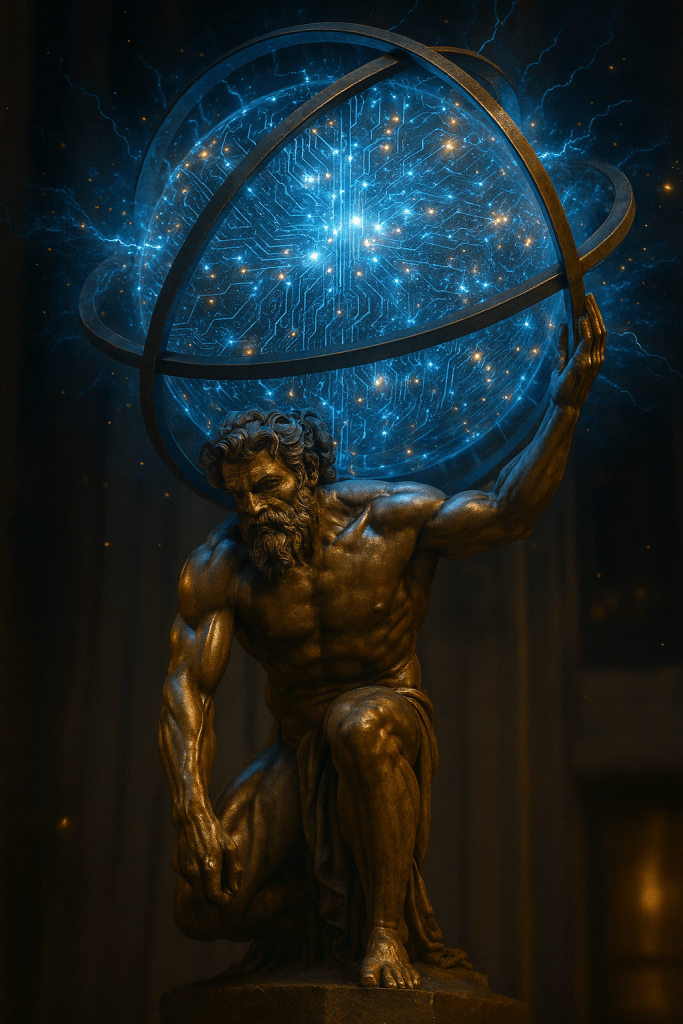
My AiTLAS is named, in part, as a name check to the ancient myth, Atlas… Let’s dig into that metaphor for a moment.
As recreation while seeking a bit of balance, I’ve been enjoying Stephen Fry’s reading of Mythos on Spotify. I am a history teacher after all… and this blog, ostensibly, is about a disrupted History pedagogy.
Let’s chat about Atlas for a moment.
Ancient Greeks imagined the sky as a solid dome, and Atlas, the Titan, stood at the western edge of the world, supporting that heavenly vault on his shoulders so it wouldn’t collapse onto the land. His role symbolised endurance, strength, and the eternal burden of defying the gods. Perhaps think of him as a cosmic scaffolding worker with a lifetime contract and no breaks… Atlas provided a scaffolding against a permanent existential threat – holding open a space in which human life, story, and meaning could unfold.
Atlas was part of the older generation of god-beings who ruled the cosmos before the Olympian gods. His parents were, on the one hand, associated with the raw potential of humankind, and, on the other representing the boundless forces encircling the world. As a mix of the two sides, Atlas was born with a dual inheritance: strength and structure from one side and fluidity and adaptability from the other.
From the moment of his birth, he existed in a world defined by cosmic tensions. Atlas grew up in an age where the very shape of the world – order, chaos, authority – was still being hammered into place.
That ancient myth provides a powerful metaphor for me for what is needed in this volatile, uncertain, complex and ambiguous age of Generative AI in education.
The “gods” of our age – perhaps our industrial age educational systems of grading and sorting, perhaps the platforms and models built by big tech — are powerful, capricious, and capable of remaking the sky above us faster than schools can respond.
Without some intentional structures, that weight can feels like it’s bearing down on students, teachers, schools, classroom practices. The weight of a systemic and technological skies can crush down upon us distorting learning rather than enriching it.
‘Order, chaos, and authority’ are in flux – yet to be hammered out – for this new world of AI.
So this is the inspiration for the name of my emerging AiTLAS project. Like Atlas, it is about supporting and scaffolding – but it’s also about flexibility and adaptability. It aims to create a way of working that’s born from a dual inheritance: an inheritance of both ancient and deeply human and new and emerging technological forces.
AiTLAS aims to offer a way forward that can bear the some of the conceptually ‘cosmic’ weight on school leaders, teachers, and administrators as they work to adapt and reinvent the experience of K-12 learning for an AI-infused age. It aims to do so by creating ways of working where learning can flourish.
AiTLAS is not an attempt to ‘resist the AI sky’, but to support the creation of a space: a space for a way of learning with AI in schools that is human, connected, curious, and purposeful.
AiTLAS, like Atlas, seeks to do the job of creating a stable and permanent space – a breathing space — where students can think, explore, ask better questions, and build meaning without being crushed by the speed or scale of a potentially inhuman AI.
Just as Atlas kept the heavens aloft so the world below could flourish, my AiTLAS project aims to keep the learning cosmos open: to present a way of working in schools that bears some of the weight, steadies the horizons of teaching, learning, and assessment in K-12 environments, and to help ensure that the forces of ‘big tech’, commerce, and politics that are shaping our age don’t collapse their vision onto us without resistance.
The VUCA nature of the AiTLAS Project
AiTLAS 2026 is intended to be an emerging, evolving and adaptive pedagogical approach. We don’t know what our AI landscape will look like in the months ahead.
Our context is volatile, uncertain, complex and ambiguous (VUCA). Any response to this AI-infused world must also be VUCA if it is to have any lasting value. While it is anticipated that AiTLAS will be a shape-shifter it will also be building upon principles and frameworks that are already in place. These principles and frameworks have been outlined in my previous work.
Further, the AiTLAS project will be grounded in the everyday work of teachers, built from reflection-in-action, and sharpened by both theoretical insights and classroom experimentation. I’ll explore these further in my next blog post – a bit of a summary of my 2025 thinking.
Looking ahead to 2026, I’ll begin formally developing AiTLAS as a more defined and research-based project, using the data sets generated through my PhD research. But already, its contours are already starting to be visible. (Again, some of these contours will be articulated in my next blog.)
Ultimately, AiTLAS will live in that messy middle space where ethics, the pragmatic considerations of the ‘real world’ of teaching, pedagogy, and cognitive science meet. The project will be a teacher’s response to the challenges of teaching in an AI-infused, VUCA world: a world where Generative AI is transforming not just how knowledge is accessed, but how it’s assembled, interrogated, applied, and made meaningful by K-12 teachers and learners.
My aim is for AiTLAS to be more than a toolkit. I’d like it to be a proactive, responsive and flexible way of thinking and working with AI.
 Disrupted History
You must be logged in to post a comment.