
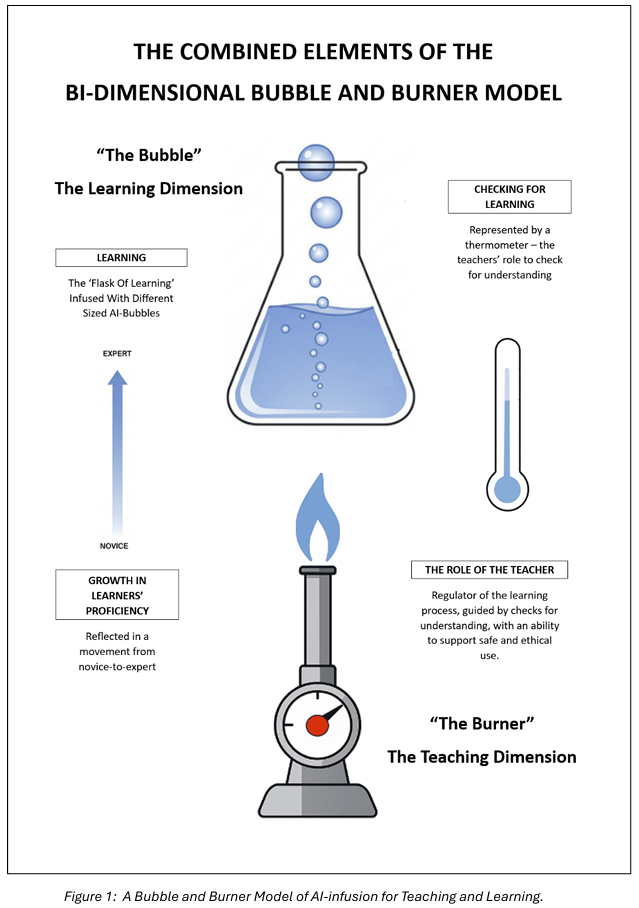
We’re entering a moment in education where the learning process itself is up for renegotiation. With generative AI now accessible to every student with a keypad, the temptation is real: skip the hard part, avoid the struggle, bypass the friction. Tools like Gemini, ChatGPT and Claude are fluent, persuasive, and increasingly responsive — so, the question we now face isn’t can our students use AI. It’s: when, how, and under what cognitive conditions should they? That’s where the metaphor of the Bubble and the Burner comes in.
The metaphor isn’t just intended to be elegant or poetic. It’s a pedagogical visualistion of learning taking place in AI-infused classrooms. It’s grounded in the work of Sweller’s Cognitive Load Theory, Dreyfus’ five-stage skill development, and the neurocognitive findings of Kosmyna et al. (2025), who caution against the accumulation of “cognitive debt.”
Teaching With Friction
What the Bubble and Burner metaphor offers is a way to speak about this moment without collapsing into binaries — not “AI is good” or “AI is bad,” but rather: how do we create the conditions under which AI enhances rather than replaces learning?
You can download a copy of the full paper from SSRN at The Bubble and Burner Model of AI-Infusion: A Framework for Teaching and Learning.
 Disrupted History
You must be logged in to post a comment.