
A student’s wisdom from within our class yarning circle
“History isn’t just about what happened. It’s about what we do with it.”
We talk a lot about AI in education right now – and yes, I use it in my planning, research, and even in drafting reflections like this one. But for all its convenience and power, it can’t do what happened in my classroom last week. It can’t feel a circle go quiet when a student says something profound. It can’t catch the tone in their voice or the look in their eye (yet?). It can’t see the look of understanding ripple around a group of teenagers.
We must keep the human in the loop. We must protect the cognitive friction that helps deep learning happen. Most of all, we must keep making space for students to speak in their own voice – because that’s where the most powerful ideas often begin.
We’ve just begun our Year 10 unit, Making Modern Australia. Using ACARA’s Australian Curriculum v9, we centre a focus of the unit on the history of the Aboriginal and Torres Strait Islander civil rights movement in Australia. This unit is the final unit of our junior course and an intent of the unit of study is to explore the contested nature of Australia’s modern history – from the struggle for recognition and land rights to the ongoing pursuit of justice and truth-telling – with an eye to developing student agency, connection, and voice.
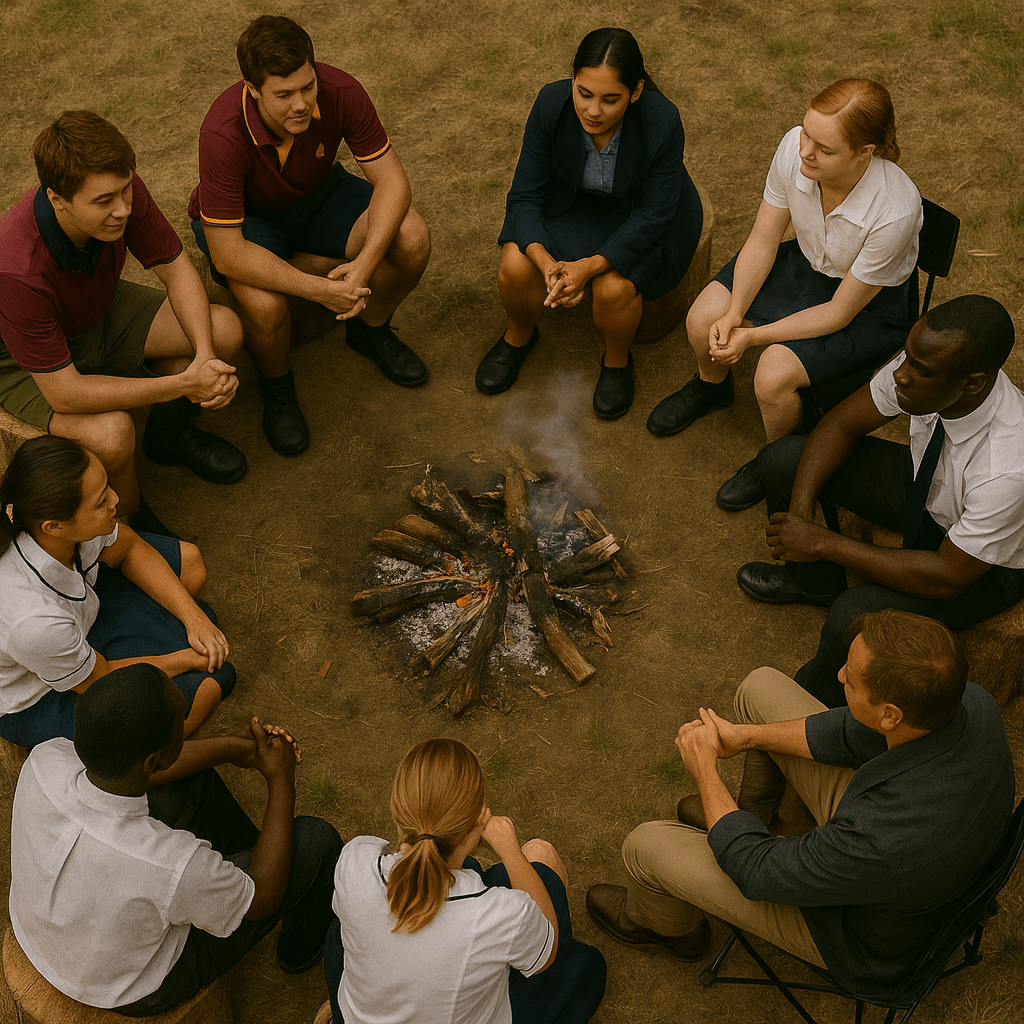
But before we touched any content or sources related to this important topic, together – as a class – we sat in a yarning circle. No slides. No whiteboard. Just a question to hold between us:
What is the purpose of history?
The student responses were thoughtful: “To understand the world,” “To not make the mistakes of the past”, “To learn from the past,” “To know who we are.”
But one student’s response stood out from the pack. In a quiet yet confident and clear voice, she found the words: “healing history“.
Upon gentle questioning, she elaborated: “We study history to help heal the hurt and harm of the past.”
healing history
Although she would never have called it this, she offered a moment of epistemic generosity – a phrase that revealed how young people, when given time and space to reflect, will produce language that has the potential to reorient the entire discipline. I’ll be taking her words and incorporating them into my studies.
My immediate instinct is not to define her concept, but to sit with it.
Teaching Within the Ethical and Affective Domains
This student’s words are not a pedagogical outlier – they are a profound invitation to revisit our disciplinary assumptions. Peter Seixas’ (2017) model of historical thinking foregrounds the ethical dimension of historical inquiry. Beyond the chronology and evidence of historical study, students must be encouraged to wrestle with moral questions: Was this right? What values were at play? How do we judge injustice across time? This isn’t a distraction from historical rigour – it is an essential part of it. It’s the core business.
Similarly, the old Queensland’s ROSBA syllabi which existed until the 1990s required history teachers to engage not just cognitions but an affective domain – it recognised that historical empathy, values decisions, and ethical tension are part of historical meaning-making. Our classrooms were expected – by those who lay the foundation of modern history pedagogy – to be spaces where students felt history as well as thought it. Doing history encompassed a call to action and justice. In this, the affective and ethical were seen not as pedagogical luxuries, but as critical to civic formation.
Sadly, this insight has largely disappeared in formal policy, but it remains deeply alive in classrooms that actively centre justice and student voice. It is also central to my school’s mission – a mission that encompasses a commitment to equity, social engagement, and critical thinking – and it provides the ethical backdrop against which that student’s phrase, “healing history,” makes complete sense.
Difficult Histories and the Role of Emotion
Teaching difficult or “hard” histories – such as colonisation, genocide, slavery, patriarchy, and racialised state violence — is often framed through the discomfort it generates. As Stoddard (2021) and Rodriguez (2020) remind us, the term “difficult” signals not only challenging content but also the emotional work students must undertake. But who decides what is ‘difficult’, and for whom?
Suh et al. (2025) insist that the experience of ‘difficulty’ in the history classroom is contextual, relational, and identity-dependent. For some students, the hard histories are both ancestral memory and daily reality; for others, they are new terrain. “Healing history,” then, doesn’t seek to offer comfort – it perhaps simply offers some measure of societal relational repair. It reframes the discomfort not as something to avoid, but as something to move through together with care.
Demoiny and Tirado (2023) warn against teaching that centres white epiphanies – where the discomfort of white students becomes the focus of the lesson. Instead, they argue for pedagogy that prioritises historical truth-telling and responsibility taken, especially for those whose stories have been excluded from dominant national narratives.
Healing as a Reparative and Generative Orientation
When I heard the phrase “healing history,” I thought immediately of Samantha Cutrara’s (2009) critique of cognitive, skills-based models of historical thinking. She argues for a reparative turn in history education – one that moves beyond intellectual engagement and into emotional, civic, and social responsibility.
Similarly, Sriprakash et al. (2020) offer the notion of generative history – history as a practice that builds futures. History that allows students not only to understand injustice but to imagine otherwise. Healing, in this context, is both personal and political: it asks students to carry the stories of the past into the project of future-making.
That student’s phrase wasn’t a slogan. It was a vision. She was saying:
This isn’t just about what happened. It’s about what we do with it.
Listening as Pedagogy
This revelation and wisdom wasn’t part of the lesson plan. But it became the lesson.
I’ve planned many lessons, and I’ll continue to do so. But in this moment – in this yarning circle – I was reminded that some of the most meaningful learning begins where our planning ends.
When students are given the space to reflect, they often lead us to places theory alone can’t reach.
When teachers don’t fill the gaps and silences with their own voice or the provision of content and activities, they open a space for the voice of students to flourish.
What if we built curriculum around that?
Where to From Here?
As we continue the Making Modern Australia unit – exploring stories of resistance, land rights, protest, and persistence – we’ll carry that student’s phrase with us.
Not as a simplification. Not as an outcome.
As a guide.
Healing history means teaching for justice.
It means staying with the uncomfortable and difficult.
It means refusing neutrality when neutrality serves the purposes of an oppressor.
It means building a classroom where truth and care sit side by side.
That student knew her why.
She shared with us and became a co-creator of knowledge in ways that I did not anticipate.
Keeping humanity in the loop!
As we find ways to thoughtfully integrate technology into our teaching, we can’t afford to flatten or fast-track the messy, emotional, ethical work that history demands. Generative AI can support us – but it must never replace the slow, relational process of building meaning together.
Healing history reminds us: students aren’t just consumers of content. They’re co-creators of knowledge. And sometimes, they’ll offer a phrase or an idea that reshapes everything – if we’re listening.
Let’s keep listening.
References (selected)
- Cutrara, S. (2009). To Placate or Provoke: A Critical Review of the Disciplines Approach to History Curriculum.
- Seixas, P. (2017). A Model of Historical Thinking.
- Suh, Y. et al. (2025). Teachers learning to teach difficult histories: Navigating role identity in varying contexts.
- Demoiny, S. & Tirado, F. (2023). I never knew this was here: White epiphanies, difficult history, and pedagogy.
- Rodriguez, N. (2020). Wrestling with difficult histories in the classroom and beyond.
- Stoddard, J. (2021). Difficult knowledge and history education.
- Sriprakash, A. et al. (2020). The pedagogical life of generative histories.
 Disrupted History
You must be logged in to post a comment.