
At the 2025 EduTechAU conference in Sydney, I posed what might seem like a simple provocation: Can AI help our students learn and thrive?
The answer I gave was emphatic: Yes.
But – and this is a vital but – only if we as educators make thoughtful, urgent, and courageous decisions now.
We are living in a moment as consequential as the cusp of the industrial revolution. It’s not that “it’s 1750 again” – it’s that we are in a 1750 moment – poised at the threshold of a new technological age, where the decisions made now will reverberate for generations. This is the essence of Mustafa Suleyman’s argument in The Coming Wave and his TED talk What is an AI anyway? AI, he contends, is not just a tool; it is a transformational force, a co-species evolving alongside us. Suleyman challenges us to recognise this as a defining shift in human history.
We must, therefore, change our metaphor as teachers. AI isn’t another tool in our educational toolkit.
That is an industrial-age conceptualisation.
Instead, we must begin to see AI as a companion, a co-learner, a twin.
Think companion, not hammer.
Think buddy, not wrench.
If we are to truly lead in this era, we need to embrace a broader paradigm: one where we teach with AI, not just about it, or using it.
Four Futures: A Fork in the Road
At the centre of my presentation, and further explored in my companion discussion paper, I outlined four strategic futures education might follow in response to AI:
- Prohibition: Ban or severely limit AI in schools.
- The Wild West: Allow unregulated, unrestricted, and largely unreflected-upon AI use.
- The Techno Trap: Surrender educational vision to technology companies, leading to algorithmic learning and de-professionalisation.
- Reimagined Pedagogies: Embrace AI through thoughtful, values-based design in a hybrid Human+AI model.
My slide deck offered a sharp contrast between these models. Only the fourth path leads us toward meaningful learning and human flourishing.
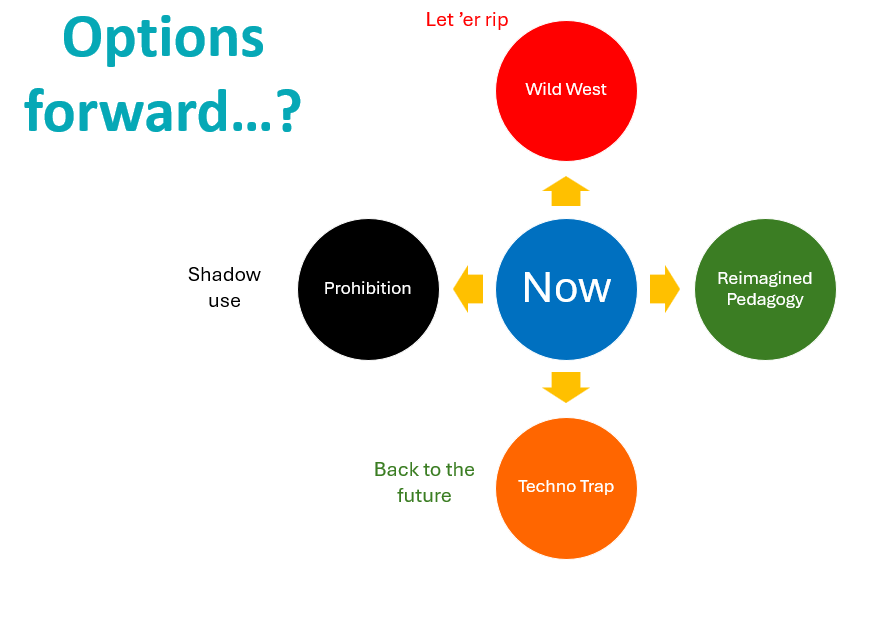
At this fork in the road, we MUST make decisions as educators. Not acting is a decision. We cannot afford to “sleepwalk” into the future. The choices before us are stark, and their consequences are already becoming visible.
Learning and Thriving: A Dual Lens for Success
In my framework, learning means achieving highly against the Australian Curriculum’s General Capabilities and Cross-Curriculum Priorities.
- These include Critical and Creative Thinking, Digital Literacy, Ethical Understanding, Intercultural Understanding, Literacy, Numeracy, and Personal and Social Capability. AI, when thoughtfully integrated, has the potential to enhance all of these.
Meanwhile, my conceptualisation for thriving draws inspiration from Martin Seligman’s PERMA model of wellbeing.
- This encompasses Positive Emotions, Engagement, Relationships, Meaning, and Accomplishment. While there are other important considerations of what it means to thrive in our lives, Seligman’s model has served as my guide for considering what it means for students to flourish in the fullest sense – not just academically, but as whole human beings.
Educators must consider both elements – learning and thriving – when designing a future that integrates AI as a co-species in our schools. One without the other risks reducing education to either mechanical proficiency or vague emotional uplift.
It is in the thoughtful interplay of both that we find a truly human-centred approach to AI-enabled education.
From Tool to Twin: Reimagining Pedagogy
What does it mean to reimagine pedagogy with AI as a symbiotic partner?
It means designing learning environments where students use AI not to bypass thinking but to extend it, to supercharge it. Where AI supports creativity, not just productivity. Where it becomes a critical companion in process that leverage the affordances of technology to assist us in building students’ empathy, their agency in their communities, their understanding of diverse perspectives, and their ability to navigate complexity.
We know from research that students thrive when their learning environments are rich with opportunities for agency, creativity, collaboration, and critical thinking.
My own pedagogical research and action learning projects reinforce that AI, integrated with care, can amplify these dimensions.
A Refreshed Role for Teachers
In this reimagined landscape, teachers aren’t replaced. They are elevated.
They become:
- Designers of generative, reparative, and transformative learning experiences
- Facilitators of civic and digital agency
- Leaders in cultivating ethical AI ecosystems
- Co-learners in an evolving digital-human partnership
Professional autonomy is restored when teachers are trusted to make evidence-informed decisions, supported by shared leadership, and given access to meaningful professional development.
The “teacher as facilitator and co-learner” concept moves beyond a platitude or a buzzword into being a vital reality.
Practical Steps Forward
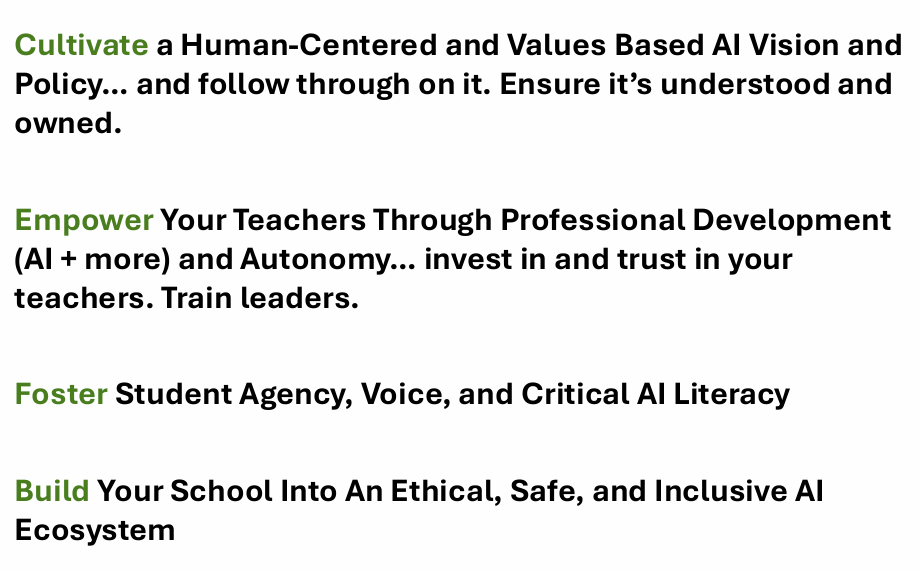
To realise the most hopeful future, education systems must:
- Craft and communicate a values-based AI vision and policy: One that is co-designed, clearly understood, and embedded across all levels.
- Invest in teacher capacity: Empower educators through high-quality professional learning that includes both AI literacy and broader pedagogical and personal renewal.
- Foster student knowledge, skills, agency and critical AI literacy: Equip young people to navigate, question, and co-create knowledge with AI.
- Build ethical, inclusive AI ecosystems: Where schools are sites of safety, belonging, and innovation.
What We Do Now Matters
As I concluded my talk, I returned to the original provocation: Can AI help our students learn and thrive?
The answer was: Yes. But…
… that future isn’t guaranteed. That hopeful future is dependent on the choices we make – today.
We need to lead with pedagogy, not platforms. The future of learning is too important to hide from or leave to chance… or to the narrow understandings of learning in the minds of ‘tech bros’.
It’s important for us to see AI not just as the latest educational tool but as a catalyst for deeper questions about what it means to learn, to teach, and to flourish in a post-AI world.
So the real question is not whether AI can help students learn and thrive. It’s this:
Will we, as educators, rise to the challenge of shaping that future now?
 Disrupted History
You must be logged in to post a comment.