
“It’s not about the technology. The human in the loop matters.” – A summary of my presentation to the 2025 QHTA State Conference.
This June, I had the privilege of delivering a presentation titled Reimagining History: Refreshing Pedagogy for an AI-Disrupted Classroom. Set against a backdrop of rapid technological change and ever-growing teacher workload, the presentation wasn’t just a demonstration of tools; it was a provocation and a call to reimagine the very core of our pedagogy.
Four Numbers
I structured my session around four numbers that, taken together, tell a story of disruption and opportunity:
30.11.22 – The date OpenAI’s ChatGPT launched publicly. Just a toddler, and yet already capable of producing content indistinguishable from human writing. In two months, it reached 100 million users – the fastest-growing technology in history.
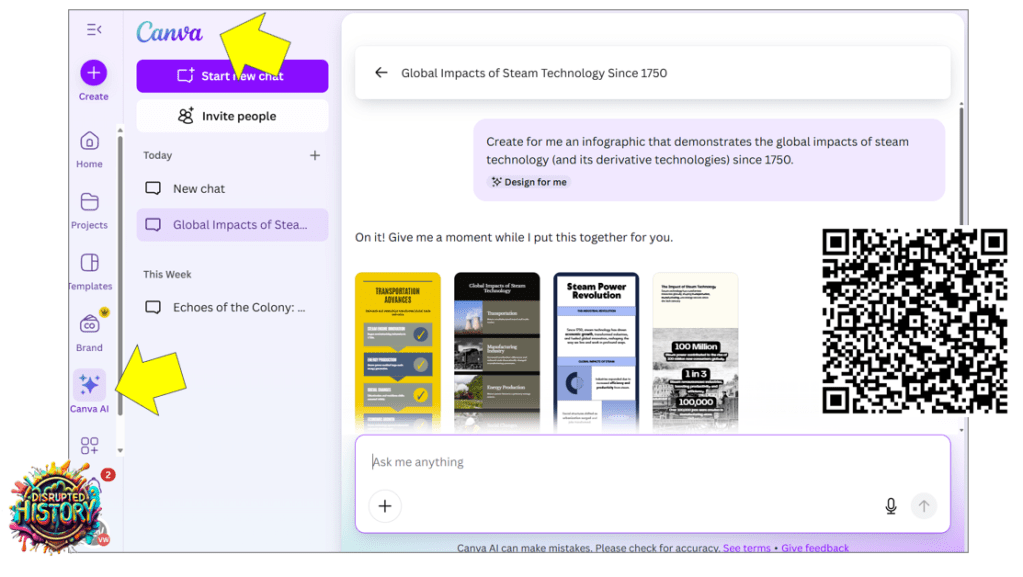
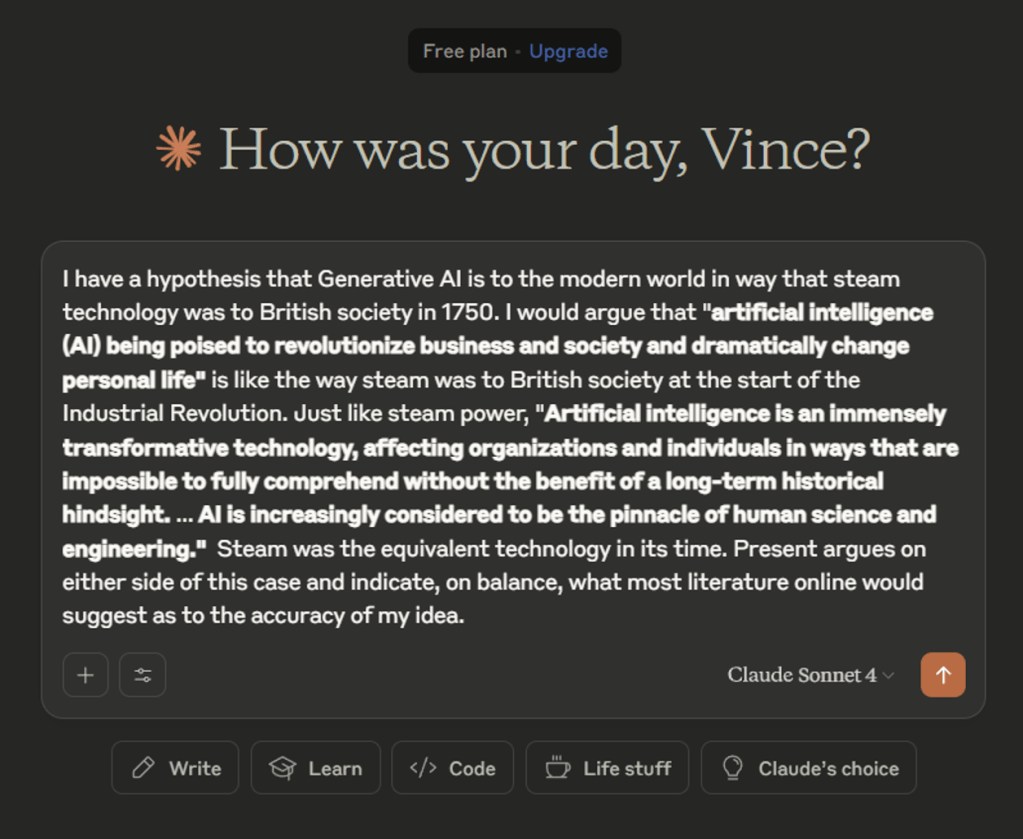
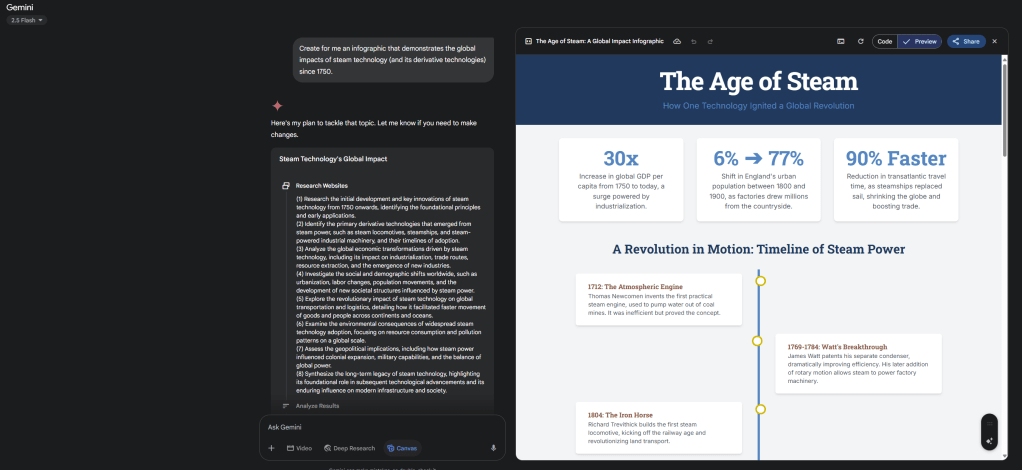
1750 – A metaphorical flashpoint. Just as steam technology revolutionised the world in the 18th century, AI is a general-purpose technology set to reshape our classrooms and our societies. Using Claude and Gemini’s deep research tools, I tested the hypothesis that AI’s impact parallels the steam revolution. The evidence? Compelling. McKinsey, WEF, and academic literature converge: the AI moment is seismic. (See the videos below.)
8:49 – The time it took Gemini (with the support of Addy and Clippy, my AI sidekicks) to draft a competent 12MHI IA3. Not perfect, but better than some student submissions I’ve marked. For students stuck at 8/25, AI could be a ladder to 15 or 16. The idea that “AI can’t do the work” is outdated and dangerously misleading. (See the videos below.)
1968 – A nod to Mary Price’s History in Danger. In her time, rote learning was killing the love of history. In ours, it might be resistance to change. If AI can already do what we ask of students, what’s our role as educators?
The AI + HI Approach
Throughout the session, I demonstrated live how ChatGPT, Gemini, and Claude – when used with human knowledge and skills – can accurately and quickly analyse sources, build arguments, and research hypotheses.
For example, at the beginning of my session, I used photos taken of conference slides used by Dr Andrew Bonnell (during his keynote on 19th-century German revolutions) to show how AI, combined with human historical intelligence, can yield powerful insights.
The tools aren’t perfect – but neither are we as teachers or our students. Used wisely, AI tools can enrich the learning experience, scaffold success, spark engagement, and supercharge learning.

Explanatory note:
While listening to the keynote, I translated, analysed, investigated, researched primary source images presented to the conference delegates. The images provided in this video were taken direct from the large screens in an auditorium. Noteworthy is how simple the prompts are. Prompts in this case are supplemented by the uploading of documents (a simplified version of build a RAG – Retrieval Augmented Generation – knowledge base).
Reimagining Pedagogy
So, what do we do?
I argued that there are only two viable paths forward:
- Get Good at the Tech – We must help students learn to use AI ethically, transparently, and as a tool to amplify their own thinking and humanity.
- Reimagine Our Pedagogy – This is the harder, braver path. It begins with recognising the historical moment we’re in and revisiting what we truly value: empathy, connection, community, agency.
I proposed a model for an AI-infused flipped pedagogy that makes space for complexity and human connection. It’s not fully formed – but that’s the point. We’re in the middle of the story.
Why This Matters
This work isn’t just about efficiency or novelty. It’s about justice. AI could be a game-changer for equity – giving voice, access, and power to students who’ve been underserved by traditional systems. But only if we’re deliberate.
As I connected the session back to my PhD research – Developing a technology-infused transformative history pedagogy to enhance students’ global, civic, and personal agency – I reminded attendees that this moment isn’t without precedent. From Dewey to Wineburg, from Freire to Pratschke, the call has always been to teach in ways that are reparative, transformative, and future-oriented.
Three Tips in Three Minutes
I ended the session with three practical tips:
- Work in Hybrid with Artificial Intelligence – Use AI with your HI (‘human intelligence’). Don’t replace the human. Supercharge the human.
- Build Cultures of Transparency – Develop student skills in using AI ethically. Model ethical practices of AI use and insist upon that in your classroom. Be curious co-users. Build trust. Don’t let covert, ‘shadow use’ be the way AI is used.
- Teach Two Routines – Develop student skills in using AI effectively. Have some core methods to share with students.
- 2 ‘I’ statements and a Verb
- Set a clear context for the AI tool and a clear direction for it to work. For example: “I am a Queensland History teacher working with… I would like to incorporate into my work more checks for understanding and… Create for me a detailed TLAP based upon the attached documents that emphasises…”
- Plus 3…
- Follow up the response to your prompt with at least 3 iterative responses using the multi-turn chat that clarify, expand upon and/or challenge the AI generated response)
- 2 ‘I’ statements and a Verb
… using these approaches with the uploading of documents
(RAG)
Addy and Clippy can help students organise and clarify.


And a final word on safety: we must keep learners, and their data protected. Ethics, always.
The Takeaway
The tools are here. The challenge is real. But the opportunity – to rehumanise education, to reimagine history teaching for deeper agency – is too powerful to ignore.
We are the ones we’ve been waiting for.
Claude investigates my hypothesis on the parallels between steam technology and AI as general purpose technologies.
An interactive infographic on the impact of steam as a general purpose technology (created by Google Gemini).
Google Gemini completes an IA3 in less than 10 minutes!
Google Gemini explores the causes of the Cuban Missile Crisis.
 Disrupted History
You must be logged in to post a comment.