
A teacher-led framework for using generative AI to deepen thinking, foster discernment, and support student agency.
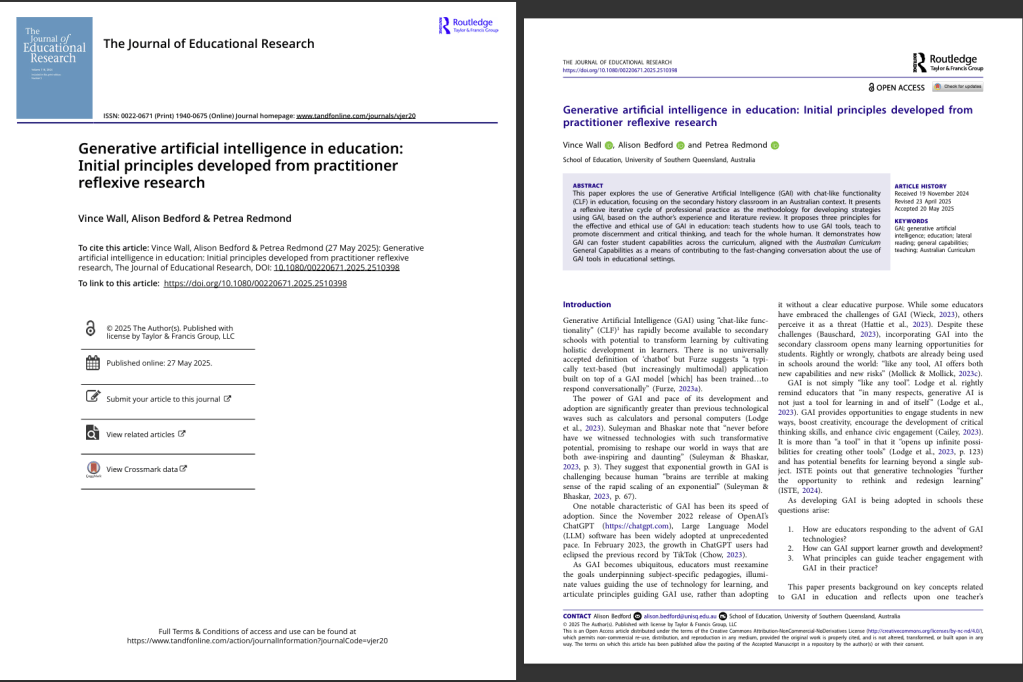
Last week, I experienced one of those quiet, surreal moments of pause: the kind you get when a milestone you’ve been working toward for months suddenly clicks into place. My first major peer-reviewed article of my PhD candidature, Generative Artificial Intelligence in Education: Initial Principles Developed from Practitioner Reflexive Research, was published in The Journal of Educational Research. Seeing it live was both thrilling and humbling.
Co-authored with two people whose intellectual generosity and professional guidance I deeply treasure – UniSQ‘s Professor Petrea Redmond and Dr Alison Bedford – this article is more than a literature review or even a classroom-based study. It’s a map-in-progress, drawn from the tensions and possibilities that have unfolded in real-time as generative artificial intelligence (GAI) arrived, uninvited but undeniably here, in our classrooms.
What the Article Is – and Isn’t
This isn’t a ‘how-to’ guide. Nor is it a sweeping theoretical manifesto. What we’ve offered instead are three initial principles—tested in practice, grounded in reflective cycles of teaching, and animated by a commitment to ethical, intentional pedagogy.
- Teach students how to use GAI tools
GAI isn’t going away. But treating it as either saviour or saboteur misses the point. Students must learn to engage with it skilfully – asking good questions, interpreting responses critically, and recognising both the tool’s capacities and its blind spots. - Teach to promote discernment and critical thinking
In an era of auto-generated everything, we need to double down on epistemic vigilance. Drawing on the work of Sam Wineburg and others in the field of digital literacy, the article suggests a “trust but verify” approach to generated content. GAI outputs can be compelling – but often subtly wrong. We propose routines and scaffolds to help students check sources, triangulate claims, and reflect on the origin, context, and plausibility of AI-generated information. - Teach for the whole human
GAI should serve – not replace – our deep work as educators: nurturing students’ agency, empathy, and ethical imaginations. Education isn’t just about what students know, but who they’re becoming.
Beyond principles, the article also offers a range of practical strategies and classroom routines that can be adapted for use across disciplines. These include simple yet powerful prompts for guiding students in how to interrogate AI-generated responses, how to map claims to sources, and how to engage in lateral reading. The routines are designed to be scalable, adaptable, and grounded in the everyday work of teachers—not theoretical ideals removed from the reality of diverse classroom contexts.
Why the General Capabilities Matter in an AI Age
A central argument of our article is that the use of generative AI in schools must be aligned with the broader aims of education – not just short-term efficiencies or shiny tech affordances. Specifically, we highlight the importance of deliberately applying the Australian Curriculum General Capabilities as a framework for engaging with AI in the classroom.
These capabilities – such as critical and creative thinking, digital literacy, ethical understanding, intercultural understanding, personal and social capability, literacy, and numeracy – aren’t optional extras. They are, in many ways, the very heart of what we are meant to be cultivating in our students. GAI, when used well, can enhance each of these – but only if its implementation is guided by clear, principled teaching.
In our my practice, I’ve seen how tools like ChatGPT can open up authentic opportunities for students to question, create, and collaborate. But without scaffolds, routines, and a values-based approach, those same tools risk reinforcing shallow engagement and surface learning.
This is why the principles we propose are not about AI per se. They’re about what kind of learners, thinkers, and citizens we want to nurture – and how AI might serve those aims rather than distract from them. The Australian Curriculum already gives us a powerful starting point. Our challenge is to ensure that the way we use GAI in schools contributes meaningfully to those educational goals.
A Moment to Thank the Village
This article would not exist without collaboration, collegiality, and community.
First and foremost, I want to express heartfelt thanks to my co-authors, Alison Bedford and Petrea Redmond. Your insight, wisdom, and support made this work richer and stronger than anything I could have done alone.
Thank you to the editors and reviewers at The Journal of Educational Research, who provided thoughtful feedback, posed hard (but important) questions, and ensured our work met the highest scholarly standards.
To my employer, thank you for valuing practitioner research. To my colleagues and students – thank you for being willing to co-inhabit the uncomfortable space of the unknown with curiosity and care. Your willingness to question, try, fail, and reflect helped shape every line of this article.
And to my extended and extensive ‘cheer squad’ – my wife, family, friends, and others in my ‘tribe’ – you’ve been the steady rhythm beneath this work. I hope you know how central you are to it.
Where This Article Fits in the Broader Picture
For those who have followed this blog, you’ll know that this article is part of a much larger inquiry. My PhD project explores how a technology-infused, transformative history pedagogy might enhance students’ civic, global, and personal agency. GAI, in many ways, has accelerated the urgency of that question. It forces us to ask: What does it mean to teach history – critically, democratically, and meaningfully – in an age when perhaps machines can ‘write’ and even think for us?
It’s not a simple question. But then again, the best ones never are.
An Invitation
If you’re wrestling with similar questions, I invite you to read the article here. Please share it with your team, annotate it in your professional learning community meetings, challenge it in your next PD session, or build upon it in your own research projects.
The principles we propose are not final. They’re starting points – offered in the spirit of praxis, collaboration, and care.
This blog will continue to track my work, my research, and my mistakes (because let’s be honest, there will be and are many).
Thank you for being part of this journey.
 Disrupted History
You must be logged in to post a comment.